
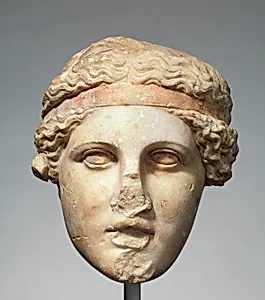
Marble head of a deity wearing a Dionysiac fillet
Unknown Artist
ca. 14–68 CE
Medium
Marble
Dimensions
H. 11 15/16 in. (30.4 cm)
Classification
Stone Sculpture
Culture & Period
Roman · Early Imperial, Julio-Claudian
Department
Greek and Roman Art
Museum
Metropolitan Museum of Art, New York, NY
Credit
Purchase, Anonymous Gift, in memory of Professor Charles M. Edwards, 1992
Accession Number
1992.11.66
Rights
Public Domain
Tags
Art Historical Context
This exquisite marble head, carved around 14–68 CE during's Early Imperial Julio-Claudian period, a deity adorned with a Dionysiac fillet ribbon headband symbolizing the god of wine, ecstasy, and theater (known as Bacchus to the Romans). Standing at nearly 12 inches (30.4 cm) high, the sculpture captures the divine figure's serene yet intense gaze, with flowing hair and finely detailed features that evoke the classical ideals of beauty and divinity. Created in the vibrant cultural milieu of the Roman Empire under emperors like Tiberius and Nero, such works reflect the fusion of Greek mythological traditions with Roman patronage. Dionysus held immense appeal in mystery cults and public festivals, representing liberation and the divine madness of revelry. This head, likely from a larger statue, underscores the Julio-Claudian era's fascination with personalized yet idealized portraits, blending portraiture realism with godly attributes. Marble, prized for its durability and luminous quality, allowed sculptors to achieve lifelike textures—from the soft curls of hair to the taut fillet—through masterful carving techniques. Acquired by the Metropolitan Museum of Art in 1992, this anonymous masterpiece invites visitors to ponder the enduring allure of ancient rituals and the artistry that immortalized them.