
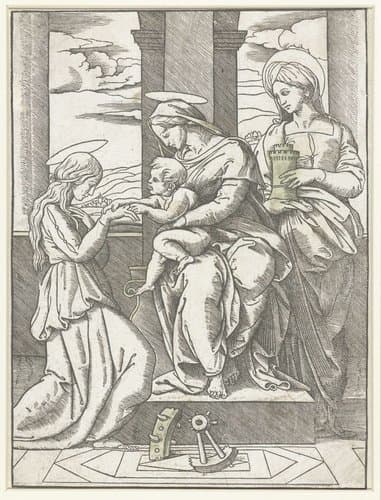
Maria met kind zittend op een troon tussen de heiligen Catharina en Barbara
1500 - 1560
Medium
hand coloring
Dimensions
183; 249
Rights
Public Domain
About this artwork
verzamelaarsmerk, verso linksonder, gestempeld: Lugt 240
Art Historical Context
Nestled in the heart of 16th-century Northern European, *Maria met kind zittend op een tro tussen de heiligen Cath en Barbara* (Mary with Child Seated on a Throne between Saints Catherine and Barbara) a timeless scene of maternal sanctity. Created anonymously between 1500 and1560, this intimate work depicts the Virgin Maryroned with the infant Jesus, flanked by scholarly Saint Catherine—symbolizing wisdom and martyrdom—and Saint Barbara, patroness of miners and those facing sudden death. Such compositions were staples of late medieval and early Renaissance piety, blending tenderness with intercessory power to inspire personal prayer. Measuring just 249 mm high by 183 mm wide, the artwork's diminutive scale suggests it was designed for private altarpieces, books of hours, or portable devotionals, common among the devout laity. The hand-coloring technique—likely applied to an underlying print or drawing—elevates its visual appeal, infusing subtle hues that mimic illuminated manuscripts. This labor-intensive process personalized mass-produced images, bridging the gap between elite manuscripts and broader audiences during the Renaissance's print revolution. A collector's mark (Lugt 240) stamped verso lower left links it to esteemed provenance, evoking the era's vibrant market for religious art. Though anonymous, this piece reflects the anonymous mastery of Netherlandish workshops, where faith and artistry intertwined to comfort souls amid turbulent times.
About the Artist
anonymous
In the vast tapestry of art history, "Anonymous" stands not as a singular individual but as a collective designation for countless unidentified creators whose works have endured across millennia. These artists, spanning prehistoric cave painters to medieval illuminators and folk craftsmen, produced the foundational layers of human visual culture. Prior to the Renaissance, when individual fame emer...