
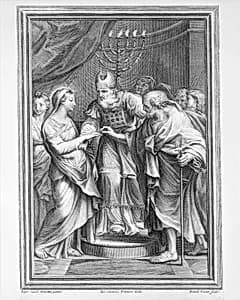
Marriage of the Virgin
1645–1724
Medium
Engraving
Dimensions
sheet: 16 1/4 x 13 in. (41.2 x 33 cm) plate: 13 1/4 x 9 1/16 in. (33.6 x 23 cm)
Classification
Prints
Department
Drawings and Prints
Museum
Metropolitan Museum of Art, New York, NY
Credit
The Elisha Whittelsey Collection, The Elisha Whittelsey Fund, 1951
Accession Number
51.501.2622
Rights
Public Domain
Tags
Art Historical Context
Behold the exquisite engraving *Marriage of the Virgin a collaborative masterpiece after designs by the renowned Italian Baroque artist Carlo Maratti (1625–1713) and executed by engraver Benoit Farjat. between 1645 and 1724, this print captures sacred moment from Christian tradition when the Virgin Mary is bethed to Saint Joseph, surrounded by attendants and overseen by a high priest. Housed in the Metropolitan Museum of Art's Drawings and Prints department, it measures an impressive sheet size of 16¼ x 13 inches, showcasing the precision of 17th-century reproductive printmaking. Engravings like this were vital in the Baroque era for disseminating grand paintings to a wider audience, allowing pilgrims, collectors, and devotees to own devotional images. Maratti, a leading figure in Roman classicism, infused his compositions with dramatic elegance and spiritual fervor, influences from Raphael and the Carracci visible in the graceful figures and architectural backdrop. Farjat's burin work brings remarkable depth through fine lines and cross-hatching, highlighting Mary's serene piety amid flowing robes and symbolic lilies. This piece from The Elisha Whittelsey Collection underscores the cultural reverence for the Virgin Mary as a model of purity and sainthood, bridging art and faith in Counter-Reformation Europe. A testament to technical virtuosity, it invites visitors to ponder the divine union that shaped Christian iconography.
About the Artist
Carlo Maratti|Benoit Farjat · 1625–1713
Son of a Dalmatian father. Known as the last major Italian artist of the classical tradition, which had originated with Raphael. He created a grandiose and decorative style that was valued by his ecclesiastical patrons. Comment on works: History; Religious.