
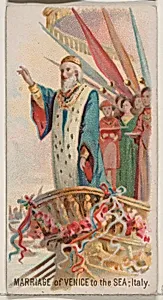
Marriage of Venice to the Sea, Italy, from the Holidays series (N80) for Duke brand cigarettes
Medium
Commercial color lithograph
Dimensions
Sheet: 2 3/4 x 1 1/2 in. (7 x 3.8 cm)
Classification
Prints|Ephemera
Department
Drawings and Prints
Museum
Metropolitan Museum of Art, New York, NY
Credit
The Jefferson R. Burdick Collection, Gift of Jefferson R. Burdick
Accession Number
63.350.204.80.27
Rights
Public Domain
Art Historical Context
Step into the vibrant world of 19th advertising with *Marriage of Venice to the Sea, Italy*, a gem from the Holidays series (N80) by W. Duke, Sons & Co. in 1890. This petite commercial color lithograph, measuring just 2 3/4 x 1 1/2 inches, was tucked into Duke brand cigarette packs as a collectible trade card. These ephemera captivated smokers and families alike, sparking a collecting craze that boosted tobacco sales during America's Gilded Age. The artwork celebrates Venice's iconic *Sposalizio del Mare* (Marriage to the Sea), a centuries-old ritual where the city's leader tossed a ring into the Adriatic to symbolize its naval dominance. Rendered in vivid chromolithography—a pioneering color printing technique— it captures festive Italian pageantry with striking hues and fine detail, despite its tiny scale. Produced by George S. Harris & Sons, these cards blended artistry with commerce, turning everyday vices into cultural souvenirs. Today, housed in the Metropolitan Museum of Art's Drawings and Prints department as part of The Jefferson R. Burdick Collection, this card whispers of marketing innovation and global wanderlust. A delightful reminder of how even the smallest prints can evoke grand histories!
About the Artist
W. Duke, Sons & Co.|George S. Harris & Sons · 1870–1920
**W. Duke, Sons & Co.: Pioneers of Chromolithographic Trade Card Art** W. Duke, Sons & Co., an American tobacco manufacturer, emerged from the entrepreneurial vision of Washington Duke (1820–1905) and his sons in Durham, North Carolina. After the Civil War, Washington abandoned farming in 1874 to join his eldest son, Brodie L. Duke, in the burgeoning tobacco trade, establishing a factory that for...