
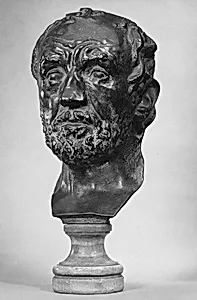
Mask of the Man with the Broken Nose (Masque de l'homme au nez cassé)
model finished in 1864, cast date unknown
Medium
Bronze
Dimensions
Overall: 12 1/2 × 7 1/4 × 6 1/8 in. (31.8 × 18.4 × 15.6 cm)
Classification
Sculpture-Bronze
Culture
French
Department
European Sculpture and Decorative Arts
Museum
Metropolitan Museum of Art, New York, NY
Credit
Bequest of Susan Vanderpoel Clark, 1967
Accession Number
67.155.13
Rights
Public Domain
Tags
Art Historical Context
Auguste Rodin's *Mask of the Man with Broken Nose* (Masque de l'homme au cassé), modeled in 1864, offers a striking glimpse into the early career of one of France's greatest sculptors. At just 24 years old Rodin crafted this intimate plaster life mask, later cast in bronze, capturing the rugged vitality of an ordinary man's face. The work exemplifies his emerging realist style, bridging classical portraiture with the raw expressiveness that would define his later masterpieces like *The Thinker*. Cast in bronze—a durable medium ideal for preserving fine details—this 12½ × 7¼ × 6⅛-inch sculpture highlights Rodin's mastery of surface texture. The broken nose and weathered features evoke a life of labor, rendered with tactile depth that invites viewers to trace the contours with their eyes. As part of the Metropolitan Museum of Art's European Sculpture and Decorative Arts collection, bequeathed by Susan Vanderpoel Clark in 1967, it underscores Rodin's pivotal role in modernizing 19th-century French sculpture, moving beyond idealization toward profound human truth. This poignant mask reminds us how Rodin found beauty in imperfection, a theme that resonated in an era of industrial change and artistic innovation.
About the Artist
Auguste Rodin · 1840–1917
François Auguste René Rodin (1840-1917) stands as the founder of modern sculpture, transforming the art form from academic tradition into expressive modernism. Born into a working-class Parisian family, Rodin faced early rejection, failing three times to gain admission to the prestigious École des Beaux-Arts. This setback forced him to work as a craftsman for nearly two decades, though his 1875 tr...