
Masks and faces
1857–58
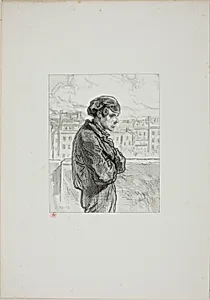
Medium
Lithograph in black on ivory wove paper
Dimensions
Image: 20.1 × 16.1 cm (7 15/16 × 6 3/8 in.); Sheet: 43.4 × 30.6 cm (17 1/8 × 12 1/16 in.)
Classification
lithograph
Department
Prints and Drawings
Museum
Art Institute of Chicago
Accession Number
11045
Rights
Public Domain
Art Historical Context
Paul Gavarni's *Masks and Faces* (1857–58) is a captivating lithograph that exemplifies the artist's mastery of social satire during France's Second Empire. Gavarni, a renowned 19th-century illustrator and caricaturist, was celebrated for his sharp observations of Parisian life, fashion, and human folly. Working in black ink on ivory wove paper, this print measures a modest image of 20.1 × 16.1 cm, yet its larger sheet (43.4 × 30.6 cm) allowed for detailed distribution in periodicals like *Le Charivari*. Lithography, a revolutionary technique Gavarni helped popularize, enabled artists to draw directly on stone for nuanced tonal effects and mass reproduction, bridging fine art and popular culture. The title *Masks and Faces* evokes the era's fascination with duality—literal masks at balls and metaphorical social facades amid Haussmann's modernizing Paris. Gavarni's incisive style blends realism with caricature, critiquing bourgeois pretensions and gender roles. Housed in the Art Institute of Chicago's Prints and Drawings Department, this work highlights lithography's role in democratizing art, making witty commentary accessible to a wide audience and preserving mid-19th-century cultural vignettes for today’s visitors.
About the Artist
Paul Gavarni · 1804–1866
Paul Gavarni, born Sulpice Guillaume Chevalier on January 13, 1804, in Paris to a cooper father from Burgundy and mother Marie-Monique Thiémet—whose brother, painter Guillaume Thiémet, served as his godfather—began his career far from the art world. As a youth, he worked in a machine factory and studied mechanical drawing at the Conservatoire des Arts et Métiers in 1818, followed by evening classe...