
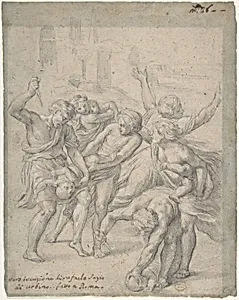
Massacre of the Innocents
Medium
Black chalk, brush and gray wash, highlighted with white gouache on light blue laid paper faded to gray-brown
Dimensions
10-7/16 x 8-1/4 in. (26.5 x 21 cm)
Classification
Drawings
Department
Drawings and Prints
Museum
Metropolitan Museum of Art, New York, NY
Credit
Gift of Cornelius Vanderbilt, 1880
Accession Number
80.3.47
Rights
Public Domain
Tags
Art Historical Context
This poignant drawing, *Massacre of the Innoc*, captures the biblical tragedy the Gospel of Matthew, where King Herod's soldiers slaughter infant in Bethlehem to eliminate the newborn Christ child. Created by an anonymous artist from the Roman-Bolognese school in 17th-century Italy, it reflects the dramatic intensity of Baroque art, a period when emotional religious scenes flourished amid the Counter-Reformation. Bologna was a hub for masterful draftsmanship, influenced by artists like the Carracci brothers, and this work exemplifies tradition's focus on human pathos and movement. Executed in black chalk, brush and gray wash, with white gouache highlights on faded light blue laid paper, the 10-7/16 x 8-1/4-inch sheet employs a monochromatic palette to model forms through subtle tonal contrasts and luminous accents. Such techniques were common in preparatory studies for paintings or engravings, allowing artists to explore composition, light, and shadow with economical precision—ideal for capturing the chaos of writhing figures, weapons, and anguished mothers. A gift to the Metropolitan Museum of Art from Cornelius Vanderbilt in 1880, this anonymous gem offers a window into 17th-century Italian workshops, where raw emotion and technical virtuosity converged to stir devotion and horror in equal measure. Its vivid depiction of massacre underscores art's power to confront violence and innocence lost.