
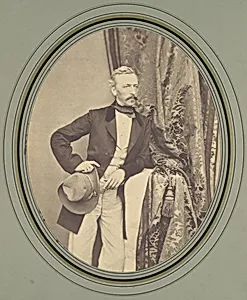
Mathias Häusermann
1850s–60s
Medium
Albumen silver print from glass negative
Dimensions
18.7 x 14.8 cm. (7 3/8 x 5 13/16 in.)
Classification
Photographs
Department
Photographs
Museum
Metropolitan Museum of Art, New York, NY
Credit
David Hunter McAlpin Fund, 1948
Accession Number
48.83.14
Rights
Public Domain
Tags
Art Historical Context
Captured in the 1850s–60s, *Mathias Häusermann* a striking portrait by Austrian photographer Franz Antoine, showcasing the burgeoning art of photography during Europe's mid-19th-century technical revolution. Antoine, known for his precise studio work, presents Häusermann—a likely bourgeois subject—with a direct gaze and dignified pose, emblematic of the era'sure that elevated everyday individuals to timeless icons. This intimate 18.7 x 14.8 cm albumen silver print, now housed in the Metropolitan Museum of Art's Photographs Department (acquired via the David Hunter McAlpin Fund in 1948), reflects the democratization of image-making as photography shifted from elite novelty to accessible memento mori. The medium's innovation lies in its albumen silver process, where a glass negative coated in egg white (albumen) suspension held light-sensitive silver salts, yielding richly toned, highly detailed prints far superior to earlier paper negatives. This technique, perfected in the 1850s, enabled crisp textures—from fabric folds to subtle facial expressions—that brought photographic realism to rival painting. Antoine's mastery highlights how such advancements fueled portraiture's popularity, preserving personal and social histories amid rapid industrialization. Culturally, this work embodies the Victorian fascination with self-presentation, where men like Häusermann commissioned images to affirm status. As one of countless mid-century cartes de visite precursors, it underscores photography's role in shaping modern identity, inviting us to ponder the subject's untold story through Antoine's unflinching lens.
About the Artist
Franz Antoine · 1815–1886
Franz Antoine (1815–1886) was an Austrian botanist and horticulturalist who served as court gardener at the Imperial Gardens of Schönbrunn in Vienna, one of the most celebrated horticultural establishments in nineteenth-century Europe. His career unfolded at the intersection of scientific botany and the decorative arts of the garden, positioning him as a key figure in the cultivation and documenta...