
Matsumoto Koshiro IV as the Fish Peddler Gorobei
Probably late 1880s or early 1890s
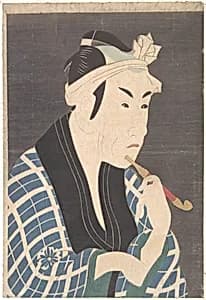
Medium
Woodblock print; ink and color on paper with mica ground
Dimensions
15 x 10 1/5 in. (38.1 x 25.9 cm)
Classification
Prints
Culture & Period
Japan · Edo period (1615–1868)
Department
Asian Art
Museum
Metropolitan Museum of Art, New York, NY
Credit
The Francis Lathrop Collection, Purchase, Frederick C. Hewitt Fund, 1911
Accession Number
JP734
Rights
Public Domain
Tags
Art Historical Context
Behold the captivating woodblock print *Matsumoto Koshiro IV as Fish Peddler Gor* by Tōshūsai Sharaku, a from Japan's Edo period (16151868). This intimate portrait, likely created in the late 1880s or early 1890s, captures the renowned kabuki actor in character as the humble yet spirited fish peddler Gorobei. Measuring just 15 x 10 1/5 inches, it exemplifies the yakusha-e genre—actor prints that immortalized theater stars for everyday fans, blending celebrity culture with artistry. Sharaku's bold style shines through in the ink and vibrant colors on paper with a shimmering mica ground, a technique that adds a luxurious, iridescent glow evoking stage lights. Woodblock printing, a hallmark of ukiyo-e ("pictures of the floating world"), allowed mass production of these affordable yet exquisite works, democratizing art during Edo Japan's urban boom. The pipe in Gorobei's hand hints at everyday realism amid kabuki's dramatic flair. Housed in the Metropolitan Museum of Art's Asian Art Department from The Francis Lathrop Collection, this print offers a window into 19th-century Japanese theater life, where actors like Matsumoto Koshiro IV were cultural icons. Its psychological intensity and meticulous detail make it a visitor favorite, celebrating the fusion of performance and printmaking.
About the Artist
Tōshūsai Sharaku · 1794–1795
Tōshūsai Sharaku stands as one of the most enigmatic figures in Japanese art history, a ukiyo-e printmaker whose brilliant career blazed for just ten months from the summer of 1794 to early spring 1795. Active exclusively in Edo (modern Tokyo), he produced approximately 150 woodblock prints and sketches, primarily yakusha-e—intimate portraits of kabuki actors captured mid-performance. Published by...