
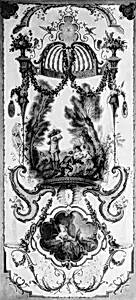
May and June (part of a set illustrating the months of the year)
second quarter 18th century
Medium
Oil on canvas; wood frame, painted yellow and gilded
Dimensions
Overall: 119 × 55 1/4 in. (302.3 × 140.3 cm)
Classification
Paintings-Decorative|Paintings|Woodwork
Culture
French
Department
European Sculpture and Decorative Arts
Museum
Metropolitan Museum of Art, New York, NY
Credit
Purchase, Joseph Pulitzer Bequest, 1922
Accession Number
22.225.2
Rights
Public Domain
Tags
Art Historical Context
**May and June** by Antoine Watteau, from the second quarter of the18th century, forms part of a charming set of overdoor paintings illustrating the months of the year Created in oil on canvas and housed in an elaborate wood frame painted yellow and gilded, these, narrow panels (119 × ¼ inches) were designed for grand French interiors, blending painting with decorative woodwork. Watteau, a master of the Rococo style infused his works with playful elegance, transitioning from the grandeur of Baroque to lighter, more intimate scenes of leisure and nature. Depicting garlands, men, and women in festive pastoral harmony, *May and June* evokes the joys of spring and early summer—blossoming romance and communal revelry. As a pioneer of *fêtes galantes*, Watteau's delicate brushwork captures fleeting moments of gallantry, with soft colors and fluid forms that emphasize movement and delight. These panels highlight the cultural vogue for seasonal cycles in 18th-century France, symbolizing the rhythm of life and nature in opulent homes. Acquired by The Metropolitan Museum of Art in 1922 through the Joseph Pulitzer Bequest, this French treasure now graces the European Sculpture and Decorative Arts department, offering visitors a glimpse into Rococo's whimsical sophistication and the artistry of integrated furnishings.
About the Artist
Antoine Watteau · 1684–1721
Jean-Antoine Watteau, born in 1684 in Valenciennes to a modest family—his father a roofer named Jean-Philippe Watteau—was the second of four sons who displayed an early passion for art. After initial apprenticeship under local painter Jacques-Albert Gérin, he moved to Paris around 1702, working in workshops copying Flemish and Dutch genre scenes. By 1705, he entered the studio of Claude Gillot, ab...