
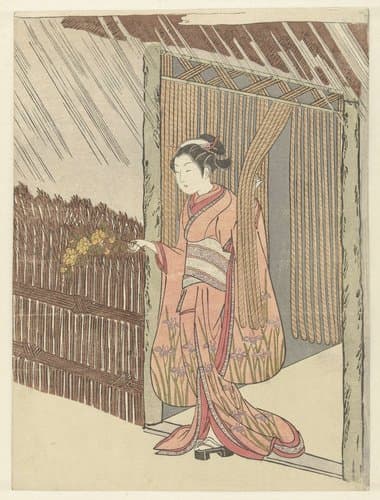
Meisje met een yamabuki tak in handen
1764 - 1768
Medium
color woodcut
Dimensions
207; 277
Rights
Public Domain
About this artwork
Meisje in roze kimono met iris patroon en in rechter hand een takje met gele bloemen, staand in deuropening.
Art Historical Context
Suzuki Harunobu's *Meisje met een yamuki tak in handen*Girl with a Yamabuki Branch in Hand), created between 1764 and 1768, captures a serene moment of everyday beauty in Edo-period Japan. This color woodcut print depicts a young woman in a delicate pink kimono adorned with iris pattern, gracefully holding a sprig of vibrant yellow yamabuki flowers in her right hand. She poised in a doorway, her figure framed softly against the intimate domestic space, evoking a sense of quiet elegance and transience. Harunobu, a master of ukiyo-e—the "pictures of the floating world" genre celebrating fleeting pleasures—pioneered full-color woodblock printing (nishiki-e) around 1765. Measuring just 277mm by 207mm, this intimate *chuban* format was designed for personal enjoyment, often collected by urban elites in 18th-century Japan. His innovative techniques layered up to 10 colors through precise carving and printing, achieving subtle gradients and luminous effects that brought subjects to life with unprecedented realism. Culturally, the yamabuki flower symbolizes a "golden heart" and spring renewal, while the iris motif on her kimono nods to seasonal festivals and resilience. This artwork exemplifies Harunobu's focus on *bijin-ga* (beautiful women), blending poetic symbolism with accessible artistry, offering visitors a window into Japan's refined aesthetic world.
About the Artist
Suzuki Harunobu · 1725–1770
Suzuki Harunobu (c. 1725-1770) was a Japanese ukiyo-e artist who revolutionized woodblock printing by developing nishiki-e—full-color prints using multiple woodblocks—in 1765. Before Harunobu, Japanese prints were limited to two or three colors; his innovation unleashed the entire artist's palette, transforming ukiyo-e into the vibrant art form that would later captivate Western artists from Manet...