
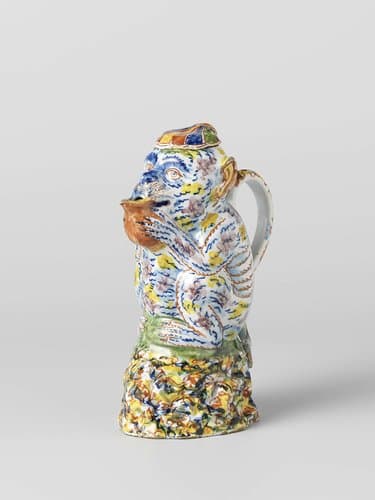
Melkkan in de vorm van een aap van veelkleurig beschilderde faïence
ca. 1750 - ca. 1780
Medium
milk jug
Dimensions
12.5; 8.2; 17.5
Rights
Public Domain
About this artwork
Schenking van de erven van de heer J.F. Loudon, Den Haag
Art Historical Context
Behold the whimsical *Melkkan in de vorm van een a van veelkleurigchilderde faïence (Milk Jug in the Form of a Monkey from Multicolored Painted Fence), a delightful anonymous creation from around 1750–1780. Standing at about 17.5 cm tall, with a width of 8.2 cm and depth of 12.5 cm, this charming jug combines functionality with playful sculpture. Crafted from faience—a tin-glazed earthenware prized for its vibrant colors and glossy finish—the piece features a monkey form adorned with multicolored paints, capturing the exuberant spirit of 18th-century European ceramics. This milk jug exemplifies the Rococo era's love for fanciful, zoomorphic designs, where everyday objects morphed into lively animal shapes to delight collectors. Faience techniques, involving intricate hand-painting over a white-glazed body fired at low temperatures, allowed artisans to achieve bold enamels in blues, greens, yellows, and reds, mimicking pricier porcelain imports from Asia. Likely produced in the Netherlands—hinted by its Dutch title and the donation from the heirs of J.F. Loudon in The Hague—it reflects the golden age of Delftware production, blending utility with artistic flair. A generous gift to the collection, this jug invites us to appreciate how anonymous makers infused daily life with humor and exotic allure, turning a simple pour of milk into a moment of wonder.
About the Artist
anonymous
In the vast tapestry of art history, "Anonymous" stands not as a singular individual but as a collective designation for countless unidentified creators whose works have endured across millennia. These artists, spanning prehistoric cave painters to medieval illuminators and folk craftsmen, produced the foundational layers of human visual culture. Prior to the Renaissance, when individual fame emer...