
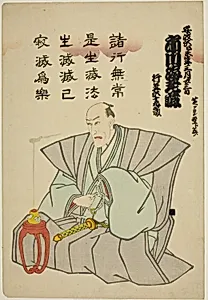
Memorial Portrait of the Actor Ichikawa Ebizo V
Medium
Color woodblock print; oban
Dimensions
35.7 × 24.2 cm (14 1/16 × 9 1/2 in.)
Classification
Department
Arts of Asia
Museum
Art Institute of Chicago
Accession Number
23792
Rights
Public Domain
Art Historical Context
This striking color woodblock print by Utagawa Kunisada I (also known as Toyokuni III) captures a memorial portrait of the renowned kabuki actor Ichikawa Ebizō V. Created in 1859, the work belongs to the rich tradition of ukiyo-e, or “pictures of the floating world,” which flourished in Japan during the late Edo period. Kunisada, one of the most prolific artists of the Utagawa school, specialized in dynamic portraits of kabuki performers, blending bold lines with vibrant colors to convey both likeness and dramatic presence. Printed in the standard oban format measuring roughly 14 by 9½ inches, the piece exemplifies the technical sophistication of Japanese woodblock printing. Multiple carved blocks allowed for precise registration of colors and fine details, making such prints affordable yet visually compelling souvenirs for theatergoers. As a memorial image, it likely commemorates the actor’s passing, a common practice that transformed personal loss into public tribute within Edo’s vibrant entertainment culture. Today housed in the Art Institute of Chicago’s Arts of Asia collection, the print offers modern viewers a window into nineteenth-century Japanese society, where actors were celebrated celebrities and their images circulated widely through mass-produced art.
About the Artist
Utagawa Kunisada I (Toyokuni III) · 1786–1864
Utagawa Kunisada I, also known as Toyokuni III (1786–1865), was born Sumida Shōgorō in the Honjo district of Edo (modern Tokyo) into a family that operated a hereditary ferry-boat service, providing stability after his father's early death. Displaying prodigious talent in drawing from childhood, he became an apprentice to the master Utagawa Toyokuni I around 1801 at age fifteen, entering the prest...