
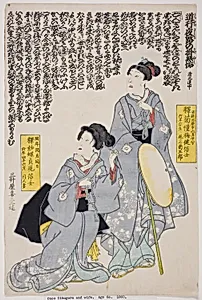
Memorial Portrait of the Actor Onoe Kikugoro IV and His Wife
1860
Medium
Color woodblock print; oban
Classification
Department
Arts of Asia
Museum
Art Institute of Chicago
Accession Number
23863
Rights
Public Domain
Art Historical Context
In the vibrant world of 19th-century Japanese uyo-e prints, this *Memorial Portrait of the Actor Onoe Kikoro IV and His Wife stands as a poignant tribute from the Utagawa School created in 1860. Rendered as a color woodblock print in large oban format—measuring about 14 by 10 inches—this artwork captures the kabuki star Onoe Kikugoro, a celebrated performer known for his expressive roles, alongside his wife. Produced shortly after his death, it exemplifies the tradition of yakusha-e, or actor prints, that immortalized theater luminaries during Japan's Edo period (1603–1868). The Utagawa School, renowned for masters like Hiroshige and Kunisada, mastered the intricate woodblock technique: carvers shaped multiple blocks for precise color layering, allowing vivid hues and fine details to emerge from a single sheet of paper. Memorial portraits like this blended reverence with dramatic flair, reflecting kabuki's cultural dominance as popular entertainment for urban audiences in Edo (modern Tokyo). These prints were affordable, mass-produced souvenirs, democratizing art and celebrity. Housed in the Art Institute of Chicago's Arts of Asia department, this piece highlights ukiyo-e's role in preserving fleeting lives amid Japan's transition to the Meiji era. Visitors will appreciate its emotional depth, evoking the "floating world" of pleasure, performance, and transience.