
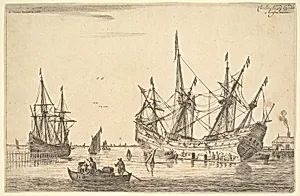
Men Caulking the Hull of a Ship
17th century
Medium
Etching; state VI
Dimensions
sheet: 7 1/2 x 11 9/16 in. (19 x 29.3 cm)
Classification
Prints
Department
Drawings and Prints
Museum
Metropolitan Museum of Art, New York, NY
Credit
The Elisha Whittelsey Collection, The Elisha Whittelsey Fund, 1962
Accession Number
62.650.175
Rights
Public Domain
Tags
Art Historical Context
In the bustling shipyards of 17th-century Holland, Reinier Nooms, known as Zeeman ("sailor"), captured the gritty labor of maritime life in *Men Caulking the of a Ship*. This depicts skilled workers sealing the wooden hull of a grand vessel with oakum and tar—a vital process to make ships watertight for the perilous seas. Nooms, a Dutch Golden Age artist renowned for his precise marine scenes, drew from firsthand observation, infusing his works with authentic detail during the Netherlands' era of naval dominance and global trade. Rendered as an etching in state VI—the final revised version of the plate—this print showcases Nooms' mastery of the intaglio technique. Etching allowed for fine lines and textures, vividly conveying the curve of the hull, the workers' tools, and the play of light on wet wood. Measuring just 7 ½ x 11 ⁹⁄₁₆ inches, its compact scale belies its technical sophistication, making it a prized example of printmaking's rise as an accessible art form. Housed in the Metropolitan Museum of Art's Drawings and Prints department, thanks to The Elisha Whittelsey Collection, this piece offers a window into the human endeavor behind Holland's seafaring empire. It reminds visitors of the unsung heroes whose craftsmanship fueled exploration and commerce.
About the Artist
Reinier Nooms, called Zeeman · 1623–1664
Reinier Nooms, known as Zeeman ("sailor" in Dutch), was a prominent Dutch maritime painter, draftsman, and etcher of the Golden Age, born around 1623 or 1624 in Amsterdam and dying there in 1664 at about age 40. Before turning to art around 1643, he led a rough life as a professional seaman, which informed his unparalleled accuracy in depicting ships, ports, naval battles, and coastal scenes—knowl...