
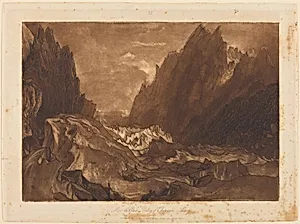
Mer de Glace
published 1812
Medium
etching and mezzotint
Classification
Department
CG-E
Museum
National Gallery of Art, Washington, D.C.
Credit
Rosenwald Collection
Accession Number
1943.3.8178
Rights
Public Domain
Art Historical Context
Step into the sublime world of J.M.W. Turner with *Mer de Glace*, a captivating 1812 print showcasing the majestic Mer de Glace glacier the French Alps. Published the Romantic era, when artists embraced nature's awe-inspiring power, Turner captures glacier's icy expanse with dramatic contrasts of light and shadow, evoking the era's fascination with the "sublime"—that thrilling mix of beauty and terror in untamed landscapes. As a pioneer of British Romanticism, Turner drew from his travels, transforming sketches into prints that brought remote wonders to eager audiences back home. Crafted in etching and mezzotint, this work highlights Turner's innovative printmaking prowess. Etching provides precise lines for structure, while mezzotint—a "dark manner" technique involving scraping a roughened copper plate—yields velvety tones and luminous effects, mimicking the atmospheric glow of his watercolors. Housed in the National Gallery of Art's Rosenwald Collection (Department CG-E), this print exemplifies how Turner democratized art, making his visionary scenes accessible beyond oil paintings. A testament to early 19th-century exploration and artistic experimentation, *Mer de Glace* invites you to ponder humanity's place amid nature's grandeur.
About the Artist
Joseph Mallord William Turner · 1775–1851
Joseph Mallord William Turner, born on 23 April 1775 in London's Covent Garden to barber William Turner and Mary Marshall, emerged as a child prodigy amid personal hardships. His mother suffered mental illness and died in Bethlem Hospital in 1804, while his father supported his early sketches by displaying them in his shop. Around age 10, Turner stayed with his uncle Joseph Mallord William Marshal...