
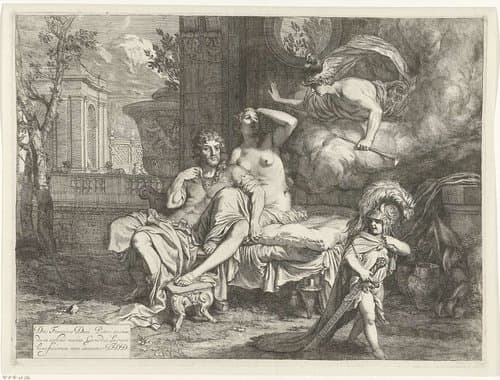
Mercurius beveelt Calypso om Odysseus te laten vertrekken
1670
Medium
etching
Dimensions
259; 483
Rights
Public Domain
About this artwork
collector's mark: Lugt 240
Art Historical Context
In the grand tradition of 17th-century European art this etching titled *Mercurius beve Calypso om Odysseus te vertrekken* (Mercury Orders Calypso to Let Odysseus Depart) captures a pivotal moment from's *Odyssey*. The anonymous artist depicts the messenger god Mercury delivering Zeus's command to the nymph Calypso, compelling her to release the hero Odysseus after seven years of captivity on her enchanted island. Such mythological scenes were immensely popular during the Dutch Golden Age, reflecting a revival of classical literature amid the era's intellectual fervor and seafaring explorations. Created as an etching in 1670, the work measures 259 mm high by 483 mm wide, showcasing the medium's precision. Etching, involving acid-etched metal plates inked and printed, allowed artists to produce intricate details and multiple impressions affordably—ideal for disseminating dramatic narratives to a wide audience. This technique's fine lines likely emphasize the divine tension and emotional interplay between figures, a hallmark of Baroque drama. Bearing the collector's mark Lugt 240, the print boasts notable provenance, linking it to esteemed historical collections. It invites us to ponder how such accessible prints bridged elite mythology with everyday viewers, preserving epic tales in tangible form.
About the Artist
anonymous
In the vast tapestry of art history, "Anonymous" stands not as a singular individual but as a collective designation for countless unidentified creators whose works have endured across millennia. These artists, spanning prehistoric cave painters to medieval illuminators and folk craftsmen, produced the foundational layers of human visual culture. Prior to the Renaissance, when individual fame emer...