
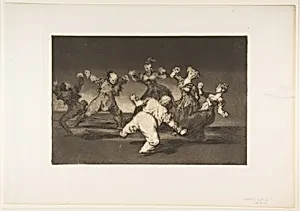
'Merry Folly' from the 'Disparates' (Follies / Irrationalities)
ca. 1815–19 (published 1864)
Medium
Etching,burnished aquatint, drypoint
Dimensions
Plate: 9 5/8 × 13 7/8 in. (24.5 × 35.3 cm) Sheet: 13 3/16 × 18 7/8 in. (33.5 × 48 cm)
Classification
Prints
Department
Drawings and Prints
Museum
Metropolitan Museum of Art, New York, NY
Credit
Harris Brisbane Dick Fund, 1924
Accession Number
24.30.13
Rights
Public Domain
Tags
Art Historical Context
Francisco de Goya y Luc, the visionary Spanish artist of the late 18th and early th centuries, created *Merry Folly* as part of his enigmatic final print series, *Disparates* (also known as *Follies* or *Irrationalities*), around 1815–19. Unpublished during Goya's lifetime due to their biting social critique, the plates were not released until 1864. This work captures the artist's evolving pessimism amid Spain's turbulent political landscape, including the Napoleonic Wars and Bourbon restoration, where he lampooned human folly, superstition, and societal absurdities through surreal, dreamlike scenes. Rendered in etching, burnished aquatint, and drypoint on a modest plate (9 5/8 × 13 7/8 in.), *Merry Folly* showcases Goya's masterful printmaking innovations. Etching provides precise lines, aquatint yields velvety tonal depths, burnishing softens highlights for ethereal effects, and drypoint adds rich, burr-like textures. Tags suggesting men and women dancing evoke a chaotic revelry, symbolizing irrational merriment amid decay—a hallmark of Goya's shift from Enlightenment satire (as in *Los Caprichos*) to darker Romantic introspection. Housed in the Metropolitan Museum of Art's Drawings and Prints department (Harris Brisbane Dick Fund, 1924), this print invites visitors to ponder Goya's enduring question: What lies beneath the mask of celebration? A testament to his technical brilliance and unflinching gaze on humanity.
About the Artist
Goya (Francisco de Goya y Lucientes) · 1746–1828
Francisco José de Goya y Lucientes (1746-1828) was a Spanish painter and printmaker considered the last of the Old Masters and the first of the moderns. Rising from modest provincial origins to become First Court Painter to Charles IV, Goya's career spanned the Enlightenment's optimism and the brutal Napoleonic invasion that shattered it. A mysterious illness in 1793 left him permanently deaf and ...