
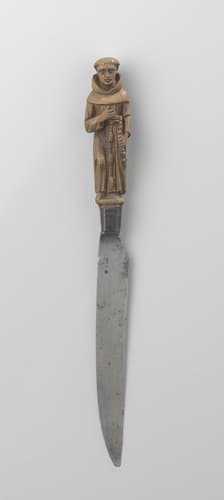
Mes met een heft in de vorm van een monnik met een rozenkrans
c. 1650 - c. 1700
Medium
boxwood (knife handle), silver (band), steel (blade)
Dimensions
2; 8.5; 23; 3
Rights
Public Domain
About this artwork
length 23 cm (total)
Art Historical Context
This exquisite pocket knife, titled *Mes met een heft in vorm van een monnik een rozenkrans* (Knife with a Handle in the Form of a with a Rosary), to around 1650–1700 and was crafted by an anonymous artist. The handle, intricately carved from dense boxwood—a favored medium for its fine grain and ability to hold exquisite detail—depicts a robed monk clutching a rosary, symbolizing Catholic devotion. A silver band adorns the base, while a sturdy steel blade extends the total length to 23 cm (handle: 8.5 × 3 × 2 cm), blending utility with artistry. Boxwood carving flourished in 17th-century Northern Europe, particularly in the Netherlands and Flanders, where skilled artisans produced small-scale masterpieces for personal items like handles, combs, and devotional objects. The monk figure exemplifies virtuoso micro-carving techniques, capturing folds of cloth, beads, and expressive features in miniature scale, likely requiring magnification tools for such precision. Culturally, this piece reflects the era's intertwining of faith and everyday life amid post-Reformation tensions, where Catholic symbols like the rosary persisted in private artifacts. As a luxury functional object, it would have appealed to devout collectors, offering both practical use and spiritual reminder in one's pocket. A rare survivor of delicate craftsmanship, it invites us to marvel at anonymous hands that turned wood into piety.
About the Artist
anonymous
In the vast tapestry of art history, "Anonymous" stands not as a singular individual but as a collective designation for countless unidentified creators whose works have endured across millennia. These artists, spanning prehistoric cave painters to medieval illuminators and folk craftsmen, produced the foundational layers of human visual culture. Prior to the Renaissance, when individual fame emer...