
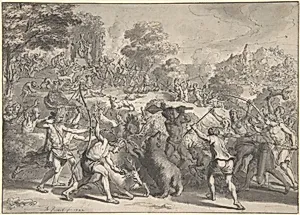
Mexican Sacrifice to the God of Hunting
1722
Medium
Pen and gray ink, brush and gray wash, over traces of graphite and red chalk, heightened with white. Contours incised. Verso reddened for transfer.
Dimensions
5 7/8 x 8 1/4 in. (14.9 x 20.9 cm)
Classification
Drawings
Department
Drawings and Prints
Museum
Metropolitan Museum of Art, New York, NY
Credit
Gift of Estate of James Hazen Hyde, 1959
Accession Number
1974.206
Rights
Public Domain
Tags
Art Historical Context
Created in 1722 by French engraver Bernard Picart, this delicate drawing captures a scene of indigenous ritual sacrifice dedicated to a hunting deity. Picart, renowned for his encyclopedic illustrations of global religious practices, produced the work as part of his ambitious project documenting ceremonies from around the world. The small sheet, measuring just under six by eight inches, depicts men with bows and arrows alongside deer and bears, reflecting European fascination with Aztec and other Mesoamerican traditions during the early Enlightenment. The drawing’s meticulous technique—pen and gray ink with wash, heightened by white—reveals Picart’s skill in preparing images for engraving. Incised contours and a reddened verso indicate it was designed for transfer to a copper plate, allowing wide dissemination through printed books. Such works offered European audiences their first visual encounters with distant cultures, blending observation with artistic interpretation. Today housed in the Metropolitan Museum’s Department of Drawings and Prints, the piece exemplifies how 18th-century artists bridged exploration and ethnography through print culture.
About the Artist
Bernard Picart · 1673–1733
Comment on works: Printmaker