
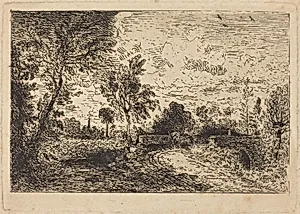
Milford Bridge
c. 1826
Medium
etching on wove paper [1st state]
Dimensions
plate: 13.3 x 19 cm (5 1/4 x 7 1/2 in.) sheet: 19.3 x 24.2 cm (7 5/8 x 9 1/2 in.)
Classification
Department
CG-E
Museum
National Gallery of Art, Washington, D.C.
Credit
Ailsa Mellon Bruce Fund
Accession Number
1987.4.2
Rights
Public Domain
Art Historical Context
John Constable's *Milford Bridge* (c. 1826) captures the serene beauty of the English countryside, a hallmark of the artist's lifelong passion for his native Suffolk landscapes. As a leading figure in British Romanticism, Constable revolutionized landscape painting by emphasizing direct observation from nature, often sketching en plein air to convey fleeting atmospheric effects like light and cloud formations. This etching depicts the picturesque Milford Bridge, likely near his beloved Dedham Vale, evoking the tranquility and everyday poetry of rural Britain during the Industrial Revolution's encroachment. Printed as a first-state etching on wove paper—a smooth, high-quality support ideal for fine detail—the work measures a modest plate size of 13.3 x 19 cm. Etching allowed Constable to translate his fluid pencil sketches into intricate lines, rendering foliage, water, and stone with remarkable precision and spontaneity. Though best known for oil paintings like *The Hay Wain*, his forays into printmaking aimed to make his visions accessible to a broader public, bridging fine art and reproductive techniques. Acquired through the Ailsa Mellon Bruce Fund and housed in the National Gallery of Art's Prints department, this rare impression highlights Constable's innovative spirit. Visitors will appreciate how it distills his genius for "skying"—those luminous skies that defined his oeuvre—into an intimate, collectible form.
About the Artist
John Constable · 1776–1837
John Constable (1776-1837) was an English landscape painter whose naturalistic depictions of the Suffolk countryside revolutionized landscape painting and established him, alongside J.M.W. Turner, as one of England's greatest artists. His work pioneered the direct observation of nature that would later influence the French Barbizon school and, ultimately, Impressionism. Born in East Bergholt, Suf...