
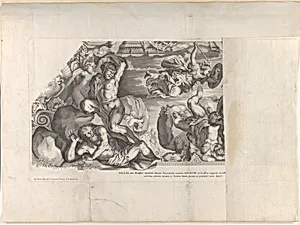
Minerva depicted at top with a shield and arrow vanquishing the Giants below, from Barberinae aulae fornix
Medium
Engraving
Dimensions
Sheet: 15 7/8 × 26 5/16 in. (40.3 × 66.8 cm) Plate: 10 1/4 × 22 13/16 in. (26 × 58 cm)
Classification
Prints|Ornament & Architecture
Department
Drawings and Prints
Museum
Metropolitan Museum of Art, New York, NY
Credit
Bequest of Phyllis Massar, 2011
Accession Number
2012.136.529(6)
Rights
Public Domain
Tags
Art Historical Context
At the apex of this dramatic 17th-century engraving the goddess Minerva triumphs over the chaotic Giants below, her shield raised and arrow poised in a classic Gigantomachy scene from classical mythology. Created around 1677 by the renowned Baroque master Pietro da Cortona (ietro Berrettini), engraving by Giovanni Giacomo de Rossi this print is part of the series *Barberinae aula fornix*, celebrating the opulent architecture of the Barberini family's Roman palace. The involvement of Gaspar de Guzman, Count-Duke of Olivares—a powerful Spanish statesman—hints at the international patronage and prestige of the Barberini popes, like Urban VIII. As a large-scale engraving (sheet measuring nearly 16 by 26 inches), it exemplifies the Baroque era's mastery of reproductive printmaking, allowing grand designs to reach collectors across Europe. Cortona's dynamic composition, with swirling figures and architectural flourishes, captures the theatrical energy of his style, blending mythology with ornamental architecture. Prints like this democratized elite art, preserving intricate details of palace vaults and arches for study and admiration. This work, now in the Metropolitan Museum of Art's Drawings and Prints collection, invites us to marvel at how 17th-century artists wove ancient myths into symbols of papal power and artistic innovation.
About the Artist
Pietro da Cortona (Pietro Berrettini)|Giovanni Giacomo De Rossi|Gaspar de Guzman, Count of Olivares and Duke of Sanlucar|Anonymous, Italian, 17th century · 1596–1669
Pietro da Cortona, born Pietro Berrettini on November 1, 1596, in the Tuscan hill town of Cortona, emerged as one of the towering figures of Italian Baroque art, excelling as a painter, architect, and decorator. He received his early training under the Florentine painters Andrea Commodi and Baccio Ciarpi. In 1612, Commodi brought the young artist to Rome, where Pietro immersed himself in the city'...