
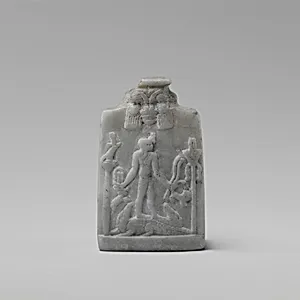
Miniature Cippus (magical stela) with Horus in profile wearing gazelle head on the forehead
Unknown Artist
ca. 712–332 B.C.
Medium
Anhydrite
Dimensions
H. 3.8 × W. 2.3 × D. 1.5 cm (1 1/2 × 7/8 × 9/16 in.)
Classification
Amulet, Cippus, profile Horus
Period
Third Intermediate Period–Late Period
Department
Egyptian Art
Museum
Metropolitan Museum of Art, New York, NY
Credit
Rogers Fund, 1957
Accession Number
57.143
Rights
Public Domain
Tags
Art Historical Context
This exquisite miniature cippus, carved from soft anhydrite stone, stands just 3.8 cm tall and served as a powerful magical stela in ancient Egypt during Third Intermediate to Late Period (ca. 712–332 B.C.), spanning Dynasties 25–30. Depicting Horus in profile, adorned with a gazelle head on his forehead rare and intriguing iconographic detail—the god likely embodies protection against dangers like crocodiles, as suggested by associated imagery. These small, portable objects were inscribed or sculpted with protective spells, often placed in homes, worn as amulets, or used in healing rituals to ward off venomous bites from snakes, scorpions, or reptiles. Cippi like this one highlight the Egyptians' deep belief in the divine power of Horus the Child (Harpocrates), who triumphed over chaos and evil. The fine carving on such a tiny scale showcases the sculptor's skill with anhydrite, a gypsum variety easy to incise yet capable of capturing delicate profiles and symbolic motifs. From the Nubian-influenced 25th Dynasty through the later Saite revival, these artifacts blended religious devotion with everyday practicality, offering reassurance in a world teeming with natural threats. Today, this Rogers Fund acquisition of 1957 at the Metropolitan Museum of Art invites us to marvel at ancient ingenuity—proof that even the smallest stone could summon godly safeguarding.