
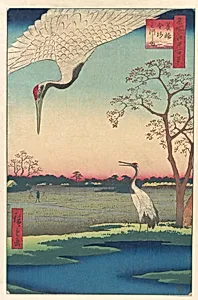
「名所江戸百景 蓑輪 金杉 三河しま」|“Minowa, Kanasugi at Mikawashima,” from the series One Hundred Famous Views of Edo (Meisho Edo hyakkei, Minowa Kanasugi, Mikawashima)
snake year 1857
Medium
Woodblock print; ink and color on paper
Dimensions
13 1/4 x 8 17/32 in. (33.7 x 21.7 cm)
Classification
Prints
Culture & Period
Japan · Edo period (1615–1868)
Department
Asian Art
Museum
Metropolitan Museum of Art, New York, NY
Credit
Rogers Fund, 1914
Accession Number
JP63
Rights
Public Domain
Tags
Art Historical Context
Utagawa Hiroshige *“Minowa, Kanasugi at Mikawashima* (1857) is a captivating woodblock print from his renowned series *One Hundred Famous of Edo*, a collection of 118 designs celebrating the landscapes and everyday scenes of Edo (modern-day Tokyo) during Japan's Edo period (16151868). Produced in the ukiyo-e tradition—“pictures of the floating world”—this print exemplifies Hiroshige's mastery in blending urban life with natural beauty, using bold colors, intricate lines, and atmospheric perspective to evoke a sense of poetic transience. The scene unfolds along the Sumida River at Minowa, featuring the graceful Kanasugi Bridge at Mikawashima, framed by misty waters and distant hills. Graceful cranes, symbols of longevity and good fortune in Japanese culture, perch nearby, adding a layer of serene symbolism amid the bustling riverside activity. Hiroshige's innovative use of color gradients and subtle shading in woodblock printing brings depth and mood, capturing the changing light of a crisp day. As a pinnacle of 19th-century Japanese printmaking, this work not only documents Edo's famous vistas but also reflects the era's fascination with nature's harmony in a growing metropolis. Housed in the Metropolitan Museum of Art, it invites viewers to ponder the enduring allure of Hiroshige's vision. (198 words)
About the Artist
Utagawa Hiroshige · 1826–1869
Utagawa Hiroshige (1797–1858), born Andō Tokutarō, was the last great master of Japanese ukiyo-e woodblock printmaking and one of the most influential landscape artists in history. Born in Edo (modern Tokyo) into a low-ranking samurai family serving as fire wardens, Hiroshige transformed landscape printmaking into a poetic meditation on nature, weather, and everyday life. His revolutionary approac...