
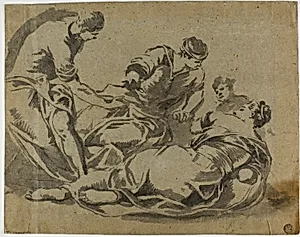
Miracle of the Loaves and Fishes
after 1602
Medium
Brush and gray wash on gray-brown laid paper
Dimensions
25.7 × 32.4 cm (10 1/8 × 12 13/16 in.)
Classification
ink or chalk wash
Department
Prints and Drawings
Museum
Art Institute of Chicago
Accession Number
95630
Rights
Public Domain
Art Historical Context
In the Prints and Drawings collection of the Art Institute of, Lucas Kilian's *Miracle of the Lo and Fishes* ( 1602) captures pivotal biblical scene from the New Testament. German artist from Augsburg, active in the early Baroque period, depicts Jesus multiplying loaves and fishes to feed the multitudes, a miracle symbolizing divine abundance and compassion. Created on modest gray-brown laid paper (257 × 32.4 cm), this intimate drawing reflects the era's renewed focus on religious narratives amid the Counter-Reformation, where art served as a tool for spiritual instruction. Kilian employs brush and gray wash—a technique blending diluted ink for subtle tonal gradations—classified here as ink or chalk wash. This monochromatic method, popular among 17th-century draftsmen, allowed for fluid modeling of light and shadow, evoking drama without color. Laid paper, with its visible chain lines from traditional manufacturing, underscores the work's status as a preparatory study or standalone sketch, showcasing Kilian's precision honed through his family's legacy in engraving. This piece invites visitors to appreciate the quiet power of wash drawings: economical yet expressive, they bridge printmaking and painting, offering a window into Baroque devotional art's emotional depth. A testament to Kilian's skill, it reminds us how everyday materials could convey eternal stories.
About the Artist
Lucas Kilian · 1579–1637
Lucas Kilian (1579–1637) was one of the most celebrated engravers of early 17th-century Germany and the most prominent member of the Kilian dynasty of printmakers in Augsburg. Born in Augsburg in 1579, Lucas Kilian achieved international recognition for his technically virtuosic engravings and became a leading figure in the transition from late Renaissance to early Baroque printmaking styles. His ...