
Mirror
Unknown Artist
13th century
Medium
Bronze; cast
Dimensions
H. 5 15/16 in. (15.08 cm) Diam. 3 in. (7.6 cm) Depth. 1/8 in. (0.3 cm)
Classification
Metal
Department
Islamic Art
Museum
Metropolitan Museum of Art, New York, NY
Credit
Gift of J. Lionberger Davis, 1967
Accession Number
67.146.2
Rights
Public Domain
Art Historical Context
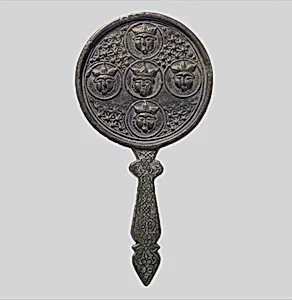
This exquisite 13th-century bronze mirror, cast in the Islamic tradition, invites visitors to ponder the daily luxuries of medieval life. Measuring just under 6 inches in height and 3 inches in diameter, this handheld object was both functional and decorative, with its slim 1/8-inch depth allowing for easy portability. Crafted through lost-wax casting—a sophisticated technique mastered by Islamic metalworkers—the mirror's reverse side likely features intricate motifs, including faces, as suggested by its catalog tags, blending utility with artistry. In the vibrant world of 13th-century Islamic art, such mirrors were prized possessions, often produced in centers like Syria, Egypt, or Persia under the patronage of sultans and merchants. Bronze, an alloy of copper and tin, was favored for its durability and ability to capture fine details through casting, enabling artisans to engrave or chase elaborate designs post-casting. These objects transcended mere reflection; they symbolized beauty, introspection, and even mystical qualities in a culture where mirrors appeared in poetry and tales like those of *One Thousand and One Nights*. Today, this mirror graces the Metropolitan Museum of Art's Islamic Art department, a gift from J. Lionberger Davis in 1967. Gaze upon it and imagine a noblewoman adjusting her veil or a scholar contemplating eternity— a timeless portal to the Islamic golden age.