
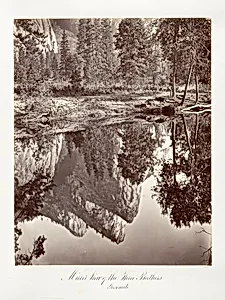
Mirror View of the Three Brothers, Yosemite
ca. 1872, printed ca. 1876
Medium
Albumen silver print from glass negative
Classification
Photographs
Department
Photographs
Museum
Metropolitan Museum of Art, New York, NY
Credit
Gift of Carole and Irwin Lainoff, Ruth P. Lasser and Joseph R. Lasser, Mr. and Mrs. John T. Marvin, Martin E. and Joan Messinger, Richard L. Yett and Sheri and Paul Siegel, 1986
Accession Number
1986.1189.38
Rights
Public Domain
Tags
Art Historical Context
Step into the majestic world of Yosemite through Carleton E. Watkins' *Mirror View of the Three Brothers, Yosemite* (ca. 1872, printed ca. 1876). This stunning albumen silver print captures iconic Three Brothers rock formation reflected in a serene mirror lake, showcasing the valley's towering granite peaks and pristine wilderness. Watkins, a pioneering American photographer, ventured into Yosemite in the 1860s with his massive camera and glass negatives, producing breathtaking images that brought the remote Sierra Nevada landscapes to a wider audience. Historically, Watkins' work played a pivotal role in the conservation movement. His Yosemite photographs, exhibited in the East, helped sway President Lincoln to sign the Yosemite Grant Act of 1864, preserving the area as the nation's first protected wilderness— a precursor to national parks. This image exemplifies his mastery of 19th-century photography, where the albumen process yielded rich tonal gradations and exquisite detail, revealing the subtle play of light on water and stone that earlier mediums couldn't match. Today, housed in The Metropolitan Museum of Art, this print invites us to marvel at nature's grandeur and Watkins' vision, reminding visitors of photography's power to inspire awe and advocacy for the environment.
About the Artist
Carleton E. Watkins · 1829–1916
Carleton E. Watkins (1829–1916), one of America's pioneering landscape photographers, was born on November 11, 1829, in Oneonta, New York, the eldest of eight children to carpenter John Watkins and innkeeper Julia. Drawn by the Gold Rush, he arrived in San Francisco in 1851 at age 22 alongside childhood friend Collis Huntington, who later became a railroad tycoon. Initially working as a carpenter ...