
Mise-en-carte (Point-paper)
1760/90
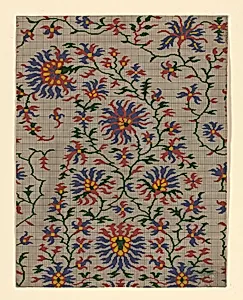
Medium
Ink and gouache on hand drawn graph paper
Dimensions
42 × 32.8 cm (16 1/2 × 12 7/8 in.)
Classification
textile
Department
Textiles
Museum
Art Institute of Chicago
Accession Number
148927
Rights
Public Domain
Art Historical Context
Step into the intricate world of 18th-century textile design with *Mise-en-carte (Point-paper)*, a delicate yet precise artwork from around 1760–90. Created by an unknown artist, this piece measures 42 × 32.8 cm and is rendered in ink and gouache on hand-drawn graph paper. Housed in the Art Institute of Chicago's Textiles Department, it exemplifies the meticulous planning behind luxurious woven fabrics of the era. "Mise-en-carte," French for "loom setup," refers to the detailed pattern charts used by weavers to program complex motifs on drawlooms, particularly in Lyon's renowned silk industry. The graph paper grid—each square representing a warp or weft thread—allowed designers to map out elaborate floral, geometric, or figurative patterns. Gouache provided vibrant color coding, while ink ensured crisp lines, bridging artistry and engineering in a pre-industrial age. This point-paper holds cultural significance as a precursor to modern textile technology, foreshadowing the Jacquard loom's punched cards in the early 19th century. It reveals the hidden labor of artisans who translated two-dimensional sketches into three-dimensional luxury goods, adorning Europe's elite with opulent silks for gowns, furnishings, and more. A testament to anonymous craftsmanship, it invites us to appreciate the precision behind period elegance.
About the Artist
Unknown
The artist designated as "Unknown" in our virtual museum's collection exemplifies a poignant chapter in art history: creators whose identities have faded into obscurity despite the enduring power of their work. With only one known artwork attributed to them in our holdings, this figure represents countless anonymous hands that shaped visual culture across centuries. Museums worldwide, including th...