
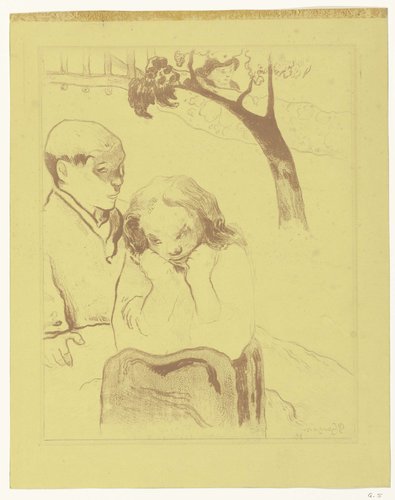
Misères humaines
1889
Medium
zincography
Dimensions
232; 291
Rights
Public Domain
About this artwork
collector's mark: Lugt 2228
Art Historical Context
**Misères humaines (Human Miseries)**, created by Paul Gauguin in1889, captures the Post-Impressionist's bold exploration of human suffering through striking zincograph—a printmaking technique using zinc plates etched with greasy ink, akin to lithography but valued for its durability and precision. Measuring just 291 × 232 mm, this work exemplifies Gauguin's innovative push into affordable multiples during a pivotal year. Fresh from his intense collaboration with Vincent van Gogh in Arles and time in Brittany's Pont-Aven artist colony, Gauguin produced a series of zincographs to share his evolving vision with a wider audience, bypassing the elitism of oil paintings. The title evokes profound empathy for life's hardships, rendered in Gauguin's signature Synthetist style: flattened forms, vibrant contours, and symbolic depth that prioritize emotion over realism. Zincography allowed him to translate his expressive drawings directly, blending fine art with reproductive techniques—a radical democratizing move amid France's fin-de-siècle artistic ferment. This print, bearing the esteemed collector's mark Lugt 2228, underscores its provenance and enduring appeal. Visitors will appreciate how *Misères humaines* foreshadows Gauguin's later Primitivist quests in Tahiti, revealing an artist attuned to universal struggles long before his tropical exile. A poignant gem in our virtual gallery! (198 words)
About the Artist
Paul Gauguin · 1848–1903
Paul Gauguin (1848-1903) was a French Post-Impressionist painter whose bold experiments with color, form, and subject matter made him one of the most influential figures in the transition from 19th-century art to modernism. His rejection of European civilization for the perceived authenticity of 'primitive' cultures established an archetype of artistic exile that continues to resonate. Gauguin's ...