
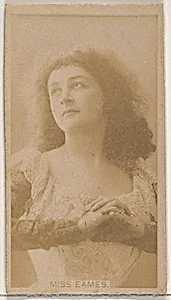
Miss Eames, from the Actors and Actresses series (N45, Type 8) for Virginia Brights Cigarettes
ca. 1888
Medium
Albumen photograph
Dimensions
Sheet: 2 5/8 x 1 1/2 in. (6.6 x 3.8 cm)
Classification
Photographs|Ephemera
Department
Drawings and Prints
Museum
Metropolitan Museum of Art, New York, NY
Credit
The Jefferson R. Burdick Collection, Gift of Jefferson R. Burdick
Accession Number
63.350.203.45.1287
Rights
Public Domain
Tags
Art Historical Context
Step into the glittering world of 19th-century theater with *Miss Eames, from the Actors and Actresses (N45, Type 8) for Virginia Bright Cigarettes*, a charming albumen photograph produced by the firm Allen & Ginter around 1888. These petite cards—measuring just 2⅝ × 1½ inches—were into cigarette packs as promotional inserts, transforming everyday smoking into a collectible pastime. Allen & Ginter, trailblazers in chromolithography and trade cards, issued fifty such portraits of stage stars, fueling a craze for celebrity memorabilia during America's Gilded Age. The albumen process, a hallmark of 19th-century photography, yields a rich, glossy image with fine detail, capturing Miss Eames' poised elegance in a format both intimate and mass-produced. As ephemera from the Metropolitan Museum of Art's Jefferson R. Burdick Collection, it exemplifies how commercial printing democratized portraiture, blending advertising savvy with cultural fandom. Actresses like Eames embodied the era's fascination with female performers, whose fame bridged vaudeville and emerging film. This tiny treasure highlights tobacco companies' role in popularizing photography and theater lore, offering a snapshot of Victorian leisure where art met commerce.
About the Artist
Allen & Ginter
Allen & Ginter, the pioneering American tobacco firm based in Richmond, Virginia, emerged around 1880 from the partnership of John F. Allen and Lewis Ginter, evolving from Allen's earlier John F. Allen & Company. Allen retired in 1882, succeeded by John Pope, yet the brand endured under Ginter's leadership, employing over 1,100 workers—mostly women—for hand-rolled cigarettes by 1886. Ginter, a Dut...