
Mitsu-yama, from the series "One Hundred No Dramas (Nogaku hyakuban)"
1898/1903
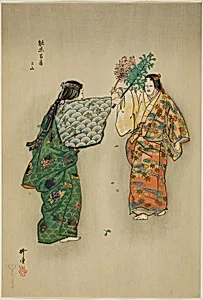
Medium
Color woodblock print
Dimensions
Approx: 37.8 × 25.6 cm (14 7/8 × 10 1/8 in.)
Classification
woodblock print
Department
Arts of Asia
Museum
Art Institute of Chicago
Accession Number
154712
Rights
Public Domain
Art Historical Context
Tsukioka Kôgyo’s “M-yama,” created between 1898 and 1903, belongs to his celebrated series *One Hundred Noh Dramas* (*Nogaku hyakuban*). Each print in the series captures a moment from a traditional Noh play, a classical Japanese theatrical form that combines music, dance, and masked performance to convey stories drawn from history, legend, and literature. Kôgyo, active during Japan’s Meiji period, devoted much of his career to preserving and interpreting this ancient art form through printmaking. As a color woodblock print measuring roughly 37.8 × 25.6 cm, the work exemplifies the refined techniques of late ukiyo-e and early shin-hanga traditions. Multiple carved blocks and subtle gradations of color allow the artist to evoke the quiet intensity and stylized gestures of Noh actors on stage. Produced at a time when Japan was rapidly modernizing, these prints served both as artistic records and as a means of cultural preservation for domestic and international audiences. Today, “Mitsu-yama” offers visitors a window into the poetic world of Noh theater. Its delicate lines and atmospheric tones invite close looking, encouraging viewers to appreciate how Kôgyo transformed fleeting stage moments into enduring images of grace and emotional depth.
About the Artist
Tsukioka Kôgyo · 1869–1927
Tsukioka Kōgyo (1869–1927), born Hanyū Bennosuke in Tokyo's bustling Nihonbashi district as the second son of an innkeeper family, navigated a path from humble origins to mastery in Japanese printmaking. After his father's early death, he was raised by his mother's Sakamaki family and apprenticed in pottery painting under his uncle, a ceramics exporter in Yokohama. He briefly attended the Tokyo Sc...