
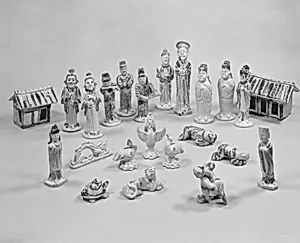
Model of Bird
Unknown Artist
Medium
Stoneware
Dimensions
H. 5 3/4 in. (14.6 cm); W. 4 1/8 in. (10.5 cm)
Classification
Tomb Pottery
Culture & Period
China · Yuan dynasty (1271–1368)
Department
Asian Art
Museum
Metropolitan Museum of Art, New York, NY
Credit
Charlotte C. and John C. Weber Collection, Gift of Charlotte C. and John C. Weber, 1994
Accession Number
1994.605.82
Rights
Public Domain
Tags
Art Historical Context
This delicate stoneware model of a bird, standing just 5¾ inches tall, hails from China's Yuan dynasty (1271–1368), a period marked by Mongol rule and cultural fusion. Crafted as tomb pottery—known as *mingqi*—it served a vital funerary purpose: to accompany the deceased into the afterlife, symbolizing vitality, freedom, or perhaps guardianship. Such small-scale models were often placed in tombs to recreate elements of the living world, ensuring comfort and prosperity for the spirit. The use of stoneware, a high-fired ceramic valued for its durability and subtle earthy tones, reflects advanced Tang-Song ceramic traditions carried into the Yuan era. Though the artist remains unknown, the piece's modest dimensions and precise form highlight the era's emphasis on realistic yet symbolic representation—evident in tags suggesting motifs of birds alongside houses, men, and women, evoking domestic scenes or communal harmony. Today, this artifact from the Charlotte C. and John C. Weber Collection graces the Metropolitan Museum of Art's Asian Art department, offering a window into Yuan beliefs in immortality and the enduring artistry of Chinese tomb wares.