
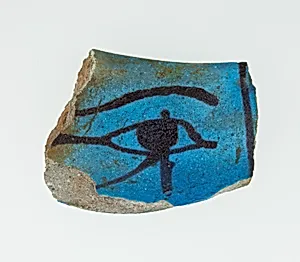
Model Throw stick fragment, eye
Unknown Artist
ca. 1479–1458 B.C.
Medium
Faience
Dimensions
L. 4.5 × W. 3.4 cm (1 3/4 × 1 5/16 in.)
Classification
Model Throw stick fragment, eye
Period
New Kingdom
Department
Egyptian Art
Museum
Metropolitan Museum of Art, New York, NY
Credit
Rogers Fund, 1923
Accession Number
23.3.82
Rights
Public Domain
Tags
Art Historical Context
This delicate faience fragment, depicting the eye of a model throw stick hails from Egypt's New Kingdom, specifically Dynasty 18 (ca. 1479–1458 B.C.), a golden age of pharaonic power under rulers like Hatshepsut Thutmose III. Throw sticks—curved, boomerang-like hunting—were commonly modeled in miniature for tomb offerings, ensuring the deceased could "hunt" in the afterlife. This small (just 4.5 x 3.4 cm) captures only the eye, a potent symbol in Egyptian iconography, evoking protection and vigilance, much like the Eye of Horus. Crafted from faience, a sophisticated composite of crushed quartz, lime, and copper-based glaze, the fragment would have gleamed with vibrant turquoise hues symbolic of eternity and the Nile's fertility. Artisans molded and fired it to mimic stone or metal prototypes, showcasing New Kingdom mastery of small-scale glazed ceramics for funerary goods. Such models reflect ancient Egyptians' belief in provisioning the ka (spirit) with everyday tools. Acquired via the Rogers Fund in 1923, this artifact at the Metropolitan Museum of Art offers a glimpse into elite burial practices, where even fragmented models held ritual power. Imagine it once whirling eternally in a noble's tomb—a tiny testament to life's continuity beyond death.