
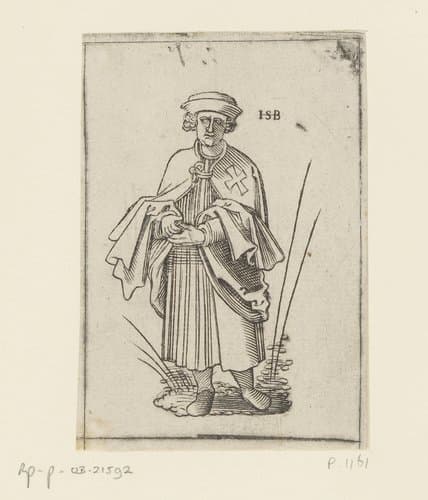
Monnik van de orde der Johannieters
after 1526
Medium
engraving
Dimensions
100; 69
Rights
Public Domain
About this artwork
Onderdeel van een serie van 28 gegraveerde kopieën in de andere richting naar Hans Sebald Behams "Das Papstthum mit seinen Gliedern", 1526.
Art Historical Context
**Monnik van de orde der Johannieters *Anonymous, after 1526, engraving, 100 × 69 mm* This delicate engraving depicts a monk from the Order the Johanniters (Kn Hospitaller), rendered in intricate detail on a tiny scale typical of Renaissance printmaking. Created anonymously after 1526, it forms part of a series of 28 engraved copies reverse the direction of Hans Sebaldham's provocative *Das Papstthum seinen Gliedern*The Papacy with its). Beham, a leading figure among the German "Little Masters," specialized in small, masterful engravings that packed bold narratives into compact formats. Produced amid the tumult of the Protestant Reformation, Beham's original 1526 series was a sharp satire critiquing the Catholic Church hierarchy, portraying papal figures—including monks and orders like the Johanniters—as corrupt or monstrous. These anonymous copies likely served to widely disseminate the anti-papal message, mirroring the image to adapt it for new printing plates. Engraving's fine lines allowed for precise reproduction, making such polemical art accessible to a broad audience despite its modest size. As a testament to the era's religious fervor and artistic ingenuity, this piece highlights how prints fueled ideological battles, bridging fine art with propaganda in Northern Renaissance Europe. Visitors can appreciate the engraver's skill in capturing Beham's dynamic style while pondering the monk's symbolic role in Reformation discourse.
About the Artist
anonymous
In the vast tapestry of art history, "Anonymous" stands not as a singular individual but as a collective designation for countless unidentified creators whose works have endured across millennia. These artists, spanning prehistoric cave painters to medieval illuminators and folk craftsmen, produced the foundational layers of human visual culture. Prior to the Renaissance, when individual fame emer...