
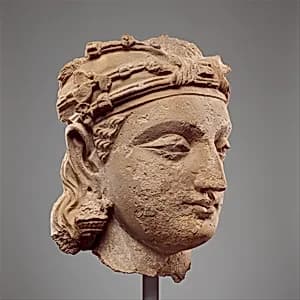
Monumental Bodhisattva Head
Unknown Artist
5th century
Medium
Stucco
Dimensions
H. 19 3/4 in. (50.2 cm); W. 10 in. (25.4 cm); D. 10 in. (25.4 cm)
Classification
Sculpture
Culture
Pakistan (ancient region of Gandhara)
Department
Asian Art
Museum
Metropolitan Museum of Art, New York, NY
Credit
Gift of Christian Humann, 1977
Accession Number
1977.191
Rights
Public Domain
Tags
Art Historical Context
This striking *Monumental Bodhisatt Head*, crafted in the 5th century from stucco in the ancient Gandhara region of present-day Pakistan, exemplifies the region's unique fusion of artistic traditions. Standing nearly 20 inches tall, this sculpture once belonged to a larger figure representing a bodhisattva—an enlightened Buddhist being who compassionately postpones full nirvana to aid others on the path to enlightenment. Gifted to the Metropolitan Museum of Art 1977 by Christian Humann, it now graces the Asian Art department, inviting visitors to ponder the spiritual depth of early Buddhist iconography. Gandhara art, flourishing from the 1st to 5th centuries CE under Kushan rule, blended Hellenistic realism—introduced via Alexander the Great's conquests—with profound Buddhist themes. The use of stucco, a versatile medium of lime plaster mixed with fibers and molded over an armature, allowed sculptors to create detailed, expressive features that could be painted and gilded for lifelike vibrancy. Though the artist remains unknown, the head's monumental scale and idealized form reflect Gandhara's mastery in conveying serenity and wisdom. For museumgoers, this piece offers a tangible link to Buddhism's spread along the Silk Road, highlighting how cultural exchanges shaped enduring symbols of compassion. Pause here to imagine its original temple setting, alive with incense and devotion.