
Mortar and Pestle
Middle Kingdom, Dynasty 12 (about 1985–1773 BCE)
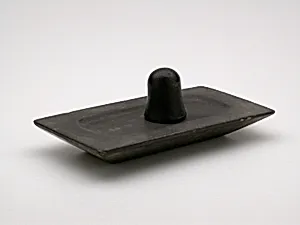
Medium
Mortar: baked steatite; pestle: granite
Dimensions
Mortar (a): 2 × 7.4 × 13.5 cm (3/4 × 2 7/8 × 5 5/16 in.); Pestle (b): 3.1 × 2.6 × 2.6 cm (1 1/4 × 1 1/16 × 1 1/16 in.)
Classification
mortar (grinding tool)
Department
Arts of Africa
Museum
Art Institute of Chicago
Accession Number
136378
Rights
Public Domain
Art Historical Context
Step back in time to Ancient Egypt's Middle Kingdom, 12 (circa 1985–1773 BCE), a golden era of stability and cultural flourishing after periods of unrest. This unassuming yet essential mortar and pestle, from baked steatite for the and durable granite for the pestle exemplifies everyday ingenuity. Measuring a compact 2 × 7.4 × 13.5 cm for the mortar 3.1 × 2.6 × 2.6 cm for thele, these tools were vital for grinding grains, spices, pigments, or medicines—tasks central to household, ritual, and artisanal life. The choice of materials highlights ancient Egyptian mastery: steatite, a soft soapstone hardened by baking, allowed precise shaping, while granite's toughness ensured longevity under repeated use. Though functional, such objects reflect the era's blend of utility and subtle artistry, often bearing traces of daily wear that speak to their lived history. Housed in the Art Institute of Chicago's Arts of Africa department, this pair invites us to appreciate the unsung heroes of ancient society—tools that sustained pharaonic grandeur from the ground up. A reminder that even the smallest artifacts unlock profound insights into a civilization's ingenuity and daily rhythms.
About the Artist
Ancient Egyptian
Ancient Egyptian artists, a collective of highly skilled artisans spanning over three millennia from the Predynastic period (c. 6000–3150 BC) to the Roman era (30 BC–4th century AD), produced some of humanity's most enduring masterpieces. These anonymous craftsmen, often organized in state-sponsored workshops, lived in dedicated communities like Deir el-Medina near Luxor during the New Kingdom (c....