
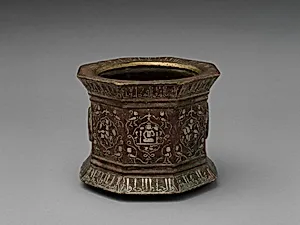
Mortar and Pestle made for Abu Bakr 'Ali Malikzad al-Tabrizi
Unknown Artist
late 12th–early 13th century
Medium
Bronze; inlaid with silver and black compound
Dimensions
Mortar: 91.1.527a H. 4 1/2 in. (11.4 cm) Diam. 5 3/4 in. (14.6 cm) Pestle: 91.1.527b H. 10 1/2 in. (26.7 cm) Diam. 2 3/8 in. (6 cm)
Classification
Metal
Department
Islamic Art
Museum
Metropolitan Museum of Art, New York, NY
Credit
Edward C. Moore Collection, Bequest of Edward C. Moore, 1891
Accession Number
91.1.527a, b
Rights
Public Domain
Tags
Art Historical Context
This exquisite mortar and pestle, crafted the late 12th to early 13th century hails from the Islamic world, likely linked to Tabriz in present-day Iran, as indicated by its dedication to Abu Bakr 'Ali Malikzad al-Tabrizi. Such functional objects were everyday tools for grinding spices, medicines, or perfumes, yet this pair exemplifies the opulence of medieval Islamic metal. Produced by an unknown artisan, it reflects the era's mastery in transforming utilitarian items into status symbols for the elite. Cast in bronze and inlaid with shimmering silver and a black compound—possibly niello for contrast—the surface bursts with intricate decorations. Arabic inscriptions and lively mythical creatures adorn its form, blending script with fantastical motifs common in Persianate art. These inlays, a sophisticated technique achieved by incising designs and hammering in precious metals, highlight the technical prowess of Islamic craftsmen during a golden age of innovation under Seljuk influence. Housed in the Metropolitan Museum of Art's Islamic Art department from the Edward C. Moore Collection, this piece (mortar: H. 4½ in., diam. 5¾ in.; pestle: H. 10½ in.) invites us to appreciate how art permeated daily life, fusing utility, piety, and whimsy in enduring bronze.