
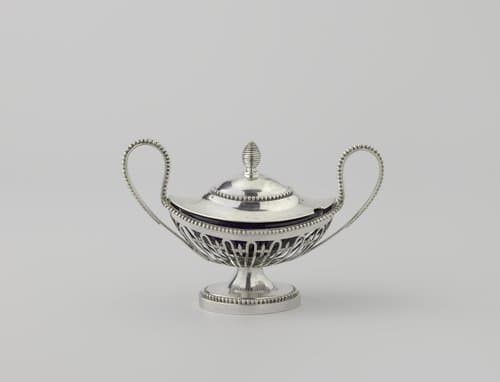
Mosterdpot, spitsovaal, met opengewerkte wand met parellijsten
1805
Medium
silver (metal)
Dimensions
169; 10.4; 15; 5.7
Rights
Public Domain
About this artwork
hoogte 10,4 cm x breedte 15 cm x diepte 5,7 cm x gewicht 169 gr (zonder binnenbak)
Art Historical Context
Nestled among the refined silver treasures of early 19th-century Europe, Nathanael Teuter's *Mosterdpot, spitsovaal, met opengewerkte wand met parellijsten* (1805) is a delicate mustard pot that exemplifies the silversmith's mastery. Crafted from gleaming silver, this pointed-oval vessel measures a modest 10.4 cm in height, 15 cm wide, 5.7 cm deep, and weighs 169 grams (excluding its inner liner). Its standout feature is the intricately openworked sidewall adorned with parellijsten—delicate pearl-like moldings that create a lace-like pattern, allowing light to dance through the metal. Teuter, a skilled Dutch silversmith active in the Napoleonic era, employed advanced chasing and piercing techniques to achieve this airy elegance. Openwork silver, or *opengewerkte* designs, was a hallmark of luxury tableware, blending functionality with ornamentation. This pot would have graced affluent dining tables, holding mustard—a popular condiment symbolizing status and culinary sophistication in bourgeois households. Its compact form and exquisite detailing highlight the era's shift toward neoclassical refinement, where everyday objects became miniature sculptures. A testament to enduring craftsmanship, this piece invites visitors to appreciate the tactile beauty of silver and the silversmith's artistry in transforming metal into heirloom poetry.