
Mother and Children
1916
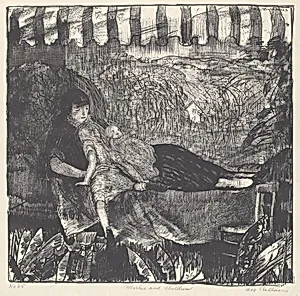
Medium
lithograph in black
Dimensions
image: 28.3 x 28.6 cm (11 1/8 x 11 1/4 in.) sheet: 42.6 x 40.9 cm (16 3/4 x 16 1/8 in.)
Classification
Department
CG-W
Museum
National Gallery of Art, Washington, D.C.
Credit
Collection of Mr. and Mrs. Paul Mellon
Accession Number
1983.1.87
Rights
Public Domain
Art Historical Context
George Bellows' *Mother and Children* (1916) captures a tender domestic moment amid the artist's signature realist style. A leading figure in the Ashcan, Bellows was renowned for gritty depictions of urban life, boxing matches, and social inequities in early 20th-century America Created during World War I, intimate lithograph shifts focus familial warmth, offering a poignant counterpoint to the era's upheavals and highlighting Bellows' versatility in portraying everyday humanity. Executed as a black-ink lithograph, the work exemplifies Bellows' mastery of this planographic printmaking technique, which allowed for bold contrasts, fluid lines, and rich tonal depth on a modest scale— the image measures 28.3 x 28.6 cm, with a larger sheet of 42.6 x 40.9 cm. Lithography suited Bellows' expressive hand, enabling him to produce affordable editions that democratized art during a time of social change. Housed in the National Gallery of Art's print collection (gift of Mr. and Mrs. Paul Mellon), *Mother and Children* underscores Bellows' impact on American modernism. Its simplicity belies a deeper cultural resonance, evoking resilience and quiet strength in the face of historical turmoil. A gem for print enthusiasts!
About the Artist
George Bellows · 1882–1925
George Wesley Bellows was born on August 12, 1882, in Columbus, Ohio, the only child of building contractor George Bellows Sr. and Anna Smith Bellows, with an older half-sister, Laura. A talented athlete who excelled in baseball and basketball at Ohio State University from 1901 to 1904, Bellows illustrated for the school yearbook before rejecting a professional baseball contract to pursue art. In ...