
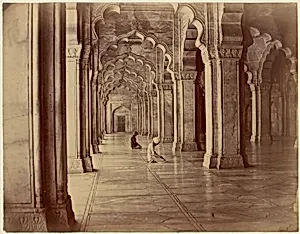
Moti Masjid: Pearl Mosque in Interior of Fort Agra
1860s–70s
Medium
Albumen silver print from glass negative
Dimensions
22.0 x 28.2 cm (8 11/16 x 11 1/8 in.)
Classification
Photographs
Department
Photographs
Museum
Metropolitan Museum of Art, New York, NY
Credit
Gift of Matthew Dontzin, 1985
Accession Number
1985.1168.17
Rights
Public Domain
Tags
Art Historical Context
This exquisite albumen silver print captures serene interior of the Motijid, or Pearl Mosque, within Agra Fort, a jewel of Mughal architecture built by Emperor Shah Jahan in 17th century. Dating to the 1860s–70s, the photograph offers a rare 19th-century glimpse into this sacred space, renowned for its pristine white marble inlays that shimmer like pearls—hence its evocative name. Agra Fort itself, a UNESCO World Heritage, was a powerhouse of imperial power during the Mughal era, blending Islamic artistry with Persian influences in its arches, domes, and intricate jaali screens. Produced as an albumen silver print from a glass negative, this medium was a hallmark of mid-19th-century photography, prized for its sharp detail, rich tonal range, and luminous highlights that beautifully render the mosque's delicate stonework and light filtering through latticed windows. Likely created by a colonial-era photographer documenting India's architectural wonders, the 22.0 x 28.2 cm image preserves the mosque's spiritual tranquility amid the British Raj's fascination with Orientalist imagery. Today, housed in the Metropolitan Museum of Art thanks to a 1985 gift from Matthew Dontzin, it bridges photography's technical evolution with the enduring cultural legacy of Mughal India, inviting visitors to ponder the interplay of light, faith, and empire.
About the Artist
Unknown
The artist designated as "Unknown" in our virtual museum's collection exemplifies a poignant chapter in art history: creators whose identities have faded into obscurity despite the enduring power of their work. With only one known artwork attributed to them in our holdings, this figure represents countless anonymous hands that shaped visual culture across centuries. Museums worldwide, including th...