
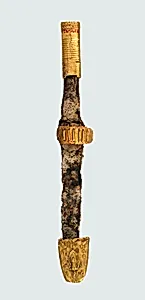
Mount from a Knife Handle
Unknown Artist
6th century
Medium
Gold, iron blade
Dimensions
Overall: 6 1/2 x 13/16 x 3 1/8 in. (16.5 x 2 x 8 cm) a-iron blade: 6 7/16 x 11/16 x 1/4 in. (16.3 x 1.8 x 0.7 cm) b-gold knife handle: 1 3/8 x 1/2 x 1/4 in. (3.5 x 1.2 x 0.6 cm) c-gold foil: 1 x 3/8 x 1/16 in. (2.5 x 1 x 0.2 cm) d-gold tip: 1 1/8 x 3/4 x 3/16 in. (2.9 x 1.9 x 0.5 cm)
Classification
Metalwork-Gold
Culture
Frankish
Department
Medieval Art
Museum
Metropolitan Museum of Art, New York, NY
Credit
Gift of J. Pierpont Morgan, 1917
Accession Number
17.191.92a–d
Rights
Public Domain
Art Historical Context
This exquisite *Mount from a Knife Handle crafted in the 6th century by an unknown Frankish artisan, a glimpse into the opulent world of early medieval Europe.ailing from the Meroving period—the era of the Frankish kingdoms that laid the foundations of modern France—this piece combines a practical iron blade with lavish gold components, including a handle mount, foil, and tip. Measuring just over 6½ inches overall, its compact form belies its status as a prestige object, likely owned by or warriors. The artistry shines in the meticulous gold metalwork, a hallmark of Frankish metalworking techniques. Gold was hammered, shaped, and possibly adorned with subtle foils to create a gleaming, durable mount that elevated a utilitarian knife into a symbol of wealth and power. Such items were not merely tools but emblems of social hierarchy, reflecting the Franks' mastery of blending functionality with luxury during a time of cultural transition from late antiquity to the Middle Ages. Today, this treasure resides in the Metropolitan Museum of Art's Medieval Art Department, a gift from J. Pierpont Morgan in 1917. It reminds us how everyday objects could embody a society's values, showcasing the Franks' skill in transforming base iron into gilded finery.