
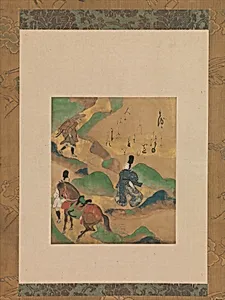
“Mount Utsu” (Utsu no yama), from The Tales of Ise (Ise monogatari)
Medium
Poem card (shikishi) mounted as a hanging scroll; ink, color, and gold on paper
Dimensions
Image: 9 11/16 × 8 3/16 in. (24.6 × 20.8 cm) Overall with mounting: 49 5/16 × 16 11/16 in. (125.3 × 42.4 cm) Overall with knobs: 49 5/16 × 18 3/8 in. (125.3 × 46.7 cm)
Classification
Paintings
Culture & Period
Japan · Edo period (1615–1868)
Department
Asian Art
Museum
Metropolitan Museum of Art, New York, NY
Credit
Mary Griggs Burke Collection, Gift of the Mary and Jackson Burke Foundation, 2015
Accession Number
2015.300.88
Rights
Public Domain
Tags
Art Historical Context
Nestled within the poetic world of *The Tales of Ise (*Ise monogatari*), a 10th-century Japanese anthology of love, travel, and courtly life, this artwork illustrates the episode "Mount Utsu" (*Utsu no yama*). Created around 1634 during Japan's Edo period (1615–1868), it captures a dramatic moment where the protagonist Ariwara no Narihira and his companions encounter a mysterious woman amid rugged mountains—evident in the tags of horses and men traversing the landscape. Tawaraya Sōtatsu, a pioneering artist of the Rinpa school, is credited with the vivid painting, while Takeuchi Toshiharu likely contributed the elegant calligraphy, blending visual artistry with literary tradition. Rendered on a poem card (*shikishi*)—a square format traditionally used for waka poetry—this delicate work employs ink, color, and gold on paper, then mounted as a hanging scroll for display. Sōtatsu's Rinpa style shines through in its bold, decorative flair: fluid ink washes suggest misty peaks, gold flecks evoke shimmering light, and dynamic compositions bring the travelers' horses and figures to life with rhythmic energy. This technique elevated fan and screen painting into intimate, poetic objects prized by literati. Housed in the Metropolitan Museum of Art's Mary Griggs Burke Collection, this piece exemplifies Edo-era fusion of classical literature and innovative art, inviting viewers to ponder the tales' themes of fleeting romance and nature's allure. A testament to Japan's enduring *mono no aware*—the pathos of things—it remains a cultural gem for poetry lovers and art enthusiasts alike.