
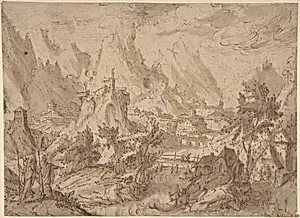
Mountainous Landscape with Tobias and the Angel
1575–1631
Medium
Pen and brown ink, brush and brown wash
Dimensions
sheet: 7 11/16 x 10 9/16 in. (19.5 x 26.9 cm)
Classification
Drawings
Department
Drawings and Prints
Museum
Metropolitan Museum of Art, New York, NY
Credit
Bequest of Harry G. Sperling, 1971
Accession Number
1975.131.195
Rights
Public Domain
Tags
About this artwork
Tobias Verhaecht's 'Mountainous Landscape with Tobias and the Angel' depicts the Old Testament story with Tobias and guardian Rafael shown left, journeying to cure Tobias's father's blindness. This late 16th century work exemplifies shift in Netherlandish art where landscape eclipsed narrative. Verhaecht gave greater prominence to sweeping mountainous terrain than biblical figures—common as landscape slowly became independent genre. Verhaecht worked in early Netherlandish landscapists tradition ...
Art Historical Context
Tobias Verhaecht's *Mountainous Landscape with Tobias the Angel*, a late 16th-century in pen and brown ink with brush and brown wash, a pivotal moment from the Old Testament Book of Tobit. On the left, the young journeys with the archangel Raphael—disguised as a guide—to retrieve a fish's gall with which to cure his father's blindness. Measuring just 7 11/16 x 10 9/16 inches, this intimate sheet from the Metropolitan Museum of Art's collection showcases Verhaecht's masterful line work and subtle tonal washes, which build depth in the sweeping terrain. What makes this work remarkable is its reflection of a transformative shift in Netherlandish art: the rise of landscape as an independent genre over religious narrative. Verhaecht, working in the tradition of early landscapists like Pieter Bruegel the Elder, prioritizes a vast "world landscape" with high horizons, jagged Alpine-inspired mountains, and distant towns, relegating the biblical figures to supporting roles. His 1590s travels to Italy infused his vistas with dramatic scale, while Mannerist touches—like curly smoke trails and elongated forms—add stylistic flair. Verhaecht revisited this subject at least three times, honing his technique and foreshadowing the bold Flemish landscapes of the 17th century. A true precursor to the Golden Age, this drawing invites you to lose yourself in its endless horizons.