
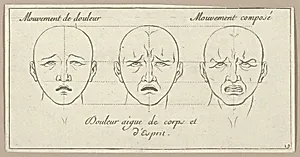
Mouvement de douleur, Douleur aigue de corps et d'Esprit, Mouvement composé (from Caractères des passions, gravés sur les desseins de l'illustre Monsieur le Brun)
Medium
Etching
Dimensions
Sheet: 2 15/16 × 5 13/16 in. (7.5 × 14.8 cm)
Classification
Prints
Department
Drawings and Prints
Museum
Metropolitan Museum of Art, New York, NY
Credit
Harris Brisbane Dick Fund, 1953
Accession Number
53.600.2896
Rights
Public Domain
Tags
Art Historical Context
In the late 17th to early 18th century, art was deeply influenced by the Académie Royale de Peinture et de Sculpture, where Charles Le Brun reigned as director and theorist. This etching, *Mouvement de douleur Douleur aigue de et d'Esprit, Mouvement composé*, from the series *Caract des passions*, captures Le Brun's meticulous studies of human emotion. Engraved by Sébastien Le Clerc the Younger after Le Brun's original designs, it vividly depicts a man's contorted face embodying acute physical and spiritual pain—a "composed movement" blending torment of body and soul. Le Brun's work drew from Cartesian philosophy and classical antiquity, systematizing facial expressions to convey universal passions, much like a visual lexicon for artists. This piece exemplifies Baroque interest in dramatic expressionism, aiding painters and sculptors in rendering authentic emotion. Le Clerc's etching technique—using acid to bite intricate lines into a metal plate—produced fine, reproducible details, making these studies widely accessible to European artists and scholars. Housed in The Metropolitan Museum of Art's Drawings and Prints department, this modest 2 15/16 × 5 13/16 in. sheet (thanks to the Harris Brisbane Dick Fund, 1953) reveals the era's fusion of science, art, and theater, inviting us to ponder the raw universality of suffering.
About the Artist
Sébastien Le Clerc, le Jeune|Charles Le Brun (French|French) · 1676 |1619 –1763 |1690
French, Paris 1676–1763 Gobelins|French, Paris 1619–1690 Paris