
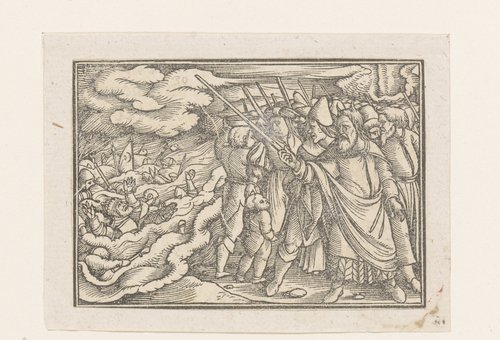
Mozes laat de legers van de Farao verzwelgen door de Rode Zee
1522
Medium
paper
Dimensions
85; 60
Rights
Public Domain
About this artwork
houtsnede en tekst in boekdruk op het recto
Art Historical Context
Behold this intricate 16th-century woodcut, *Mozes laat de leg van de Faraozwelgen door de Zee* (Moses Causes Pharaoh's Armies to Be Swallowed the Red Sea), an masterpiece from 1522. Measuring just 60mm high by 85mm wide on paper, it captures the dramatic biblical climax from the Book of Exodus, where the parted waters of the Red Sea crash down upon the pursuing Egyptian forces, sealing Israel's miraculous escape from slavery. Rendered in recto side with integratedpress text, this tiny yet powerful image invites close inspection, revealing the chaos of churning waves, flailing chariots, and divine retribution. Created during the Northern Renaissance, when woodcuts flourished as an accessible medium for disseminating religious narratives through printed books, this piece exemplifies relief printing techniques. The artist carved the design into a woodblock, inking the raised surfaces to transfer bold, high-contrast lines onto paper alongside movable type text— a revolutionary combination that made scripture vivid and affordable for the masses amid the early Reformation's fervor. Its cultural resonance endures as a testament to faith triumphing over tyranny, a motif that resonated deeply in an era of religious upheaval. Though anonymous, the work's meticulous detail and emotional intensity highlight the era's devotion to storytelling through art, offering visitors a window into how everyday Europeans visualized sacred history.
About the Artist
anonymous
In the vast tapestry of art history, "Anonymous" stands not as a singular individual but as a collective designation for countless unidentified creators whose works have endured across millennia. These artists, spanning prehistoric cave painters to medieval illuminators and folk craftsmen, produced the foundational layers of human visual culture. Prior to the Renaissance, when individual fame emer...