
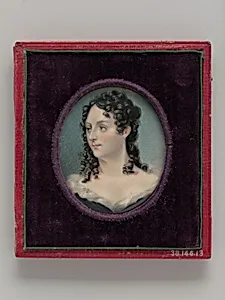
Mrs. George Catlin (Clara Bartlet Gregory)
ca. 1830
Medium
Watercolor on ivory
Dimensions
2 x 1 3/4 in. (5.1 x 4.4 cm)
Classification
Painting, miniature
Culture
American
Department
The American Wing
Museum
Metropolitan Museum of Art, New York, NY
Credit
Fletcher Fund, 1938
Accession Number
38.146.13
Rights
Public Domain
Tags
Art Historical Context
Step into the intimate world of early 19th-century American portraiture with George Cat's *Mrs. George Catlin (ara Bartlet Gregory)* created around 1830. This tender depiction captures Catlin's wife, Clara, in a miniature format—measuring just 2 x 1¾ inches—perfect for a locket or pocket case, evoking the personal devotion of the era. Catlin, best known for his vibrant oil paintings of Native American life during his Western travels in the 1830s, here reveals his roots as an Eastern portraitist, blending affection with professional skill. Painted in watercolor on ivory, a prized medium for miniatures, the work showcases the translucent luminosity and fine detail that ivory's smooth surface affords. Watercolor allowed Catlin to layer delicate glazes for lifelike skin tones and expressive features, a technique rooted in 18th-century European traditions but thriving in America's burgeoning middle class. These tiny treasures served as cherished mementos for travelers, soldiers, or newlyweds like the Catlins, who married in the late 1820s. Housed in the Metropolitan Museum of Art's American Wing, this piece highlights the domestic side of Catlin's career before his epic frontier adventures. It underscores women's roles in early American society—often the quiet anchors behind public figures—and the cultural prestige of portrait miniatures as symbols of status and sentiment. A window into private life amid national expansion.
About the Artist
George Catlin · 1796–1872
George Catlin (1796–1872), born in Wilkes-Barre, Pennsylvania, to Putnam Catlin and Polly Sutton—who had been captured by Native Americans during the 1778 Battle of Wyoming—initially pursued a legal career. Trained at Litchfield Law School, he was admitted to the bar in 1819 but abandoned law after two years to study art in Philadelphia in 1823. Self-taught as a portraitist, Catlin quickly gained ...