
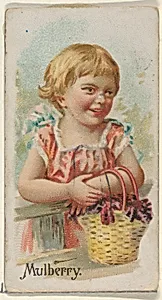
Mulberry, from the Fruits series (N12) for Allen & Ginter Cigarettes Brands
Medium
Commercial color lithograph
Dimensions
Sheet: 2 3/4 x 1 1/2 in. (7 x 3.8 cm)
Classification
Prints|Ephemera
Department
Drawings and Prints
Museum
Metropolitan Museum of Art, New York, NY
Credit
The Jefferson R. Burdick Collection, Gift of Jefferson R. Burdick
Accession Number
63.350.201.12.30
Rights
Public Domain
Tags
Art Historical Context
**Mulberry, from the Fruits (N12) for Allen & Ginter Cig Brands** This delightful chromolithograph, measuring just 2¾ × 1½ inches, captures the luscious mulberry fruit alongside charming girls, as part of Allen & Ginter's popular Fruits series (N12 issued in 1891. Produced as inserts for cigarette packs by the pioneering tobacco company Allen & Ginter in collaboration with lithographers George S. Harris Sons, these cards were designed to entice collectors and boost brand loyalty during the Gilded Age boom in consumer advertising. The medium of commercial color lithography—chromolithography—allowed for vibrant, multi-layered hues that mimicked hand-painted artwork at scale, revolutionizing mass-produced ephemera. Though tiny, these prints exemplify the era's fusion of whimsy and commerce, blending botanical accuracy with playful human elements to appeal to a wide audience, including children who traded them avidly. Today, housed in the Metropolitan Museum of Art's Jefferson R. Burdick Collection, "Mulberry" highlights the cultural role of trade cards in 19th-century America, bridging art, advertising, and collecting. They offer a window into how everyday luxuries like cigarettes were marketed with artistic flair, preserving a slice of Victorian visual culture.
About the Artist
Allen & Ginter|George S. Harris & Sons
Allen & Ginter, the pioneering American tobacco firm based in Richmond, Virginia, emerged around 1880 from the partnership of John F. Allen and Lewis Ginter, evolving from Allen's earlier John F. Allen & Company. Allen retired in 1882, succeeded by John Pope, yet the brand endured under Ginter's leadership, employing over 1,100 workers—mostly women—for hand-rolled cigarettes by 1886. Ginter, a Dut...