
Mutsenslip van kloskant
ca. 1725 - ca. 1749
Medium
Brussels bobbin lace
Dimensions
11; 117
Rights
Public Domain
About this artwork
width 11 cm x length 117 cm
Art Historical Context
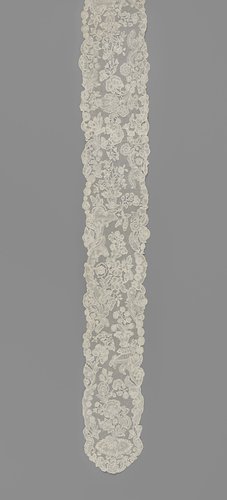
### Mutsenslip vanloskant This delicate *mutsenslip van kloskant or bobbin lace cap strip,ails from the golden age of Flemish lace-making, dating to around 1725–1749. Measuring a slender 11 cm wide by 117 cm long, it crafted anonymously by skilled artisans in Brussels, a hub of lace production during the 18th century. Likely intended as a decorative insert or edging for a woman's cap (*muts*), it exemplifies the exquisite trimmings that adorned elite European fashion, transforming everyday garments into symbols of status and refinement. Brussels bobbin lace, the medium here, is renowned for its intricate technique: fine linen threads twisted and plaited on bobbins over a pillow-pattern, creating a dense, grounded fabric with precise floral or geometric motifs. Unlike needle lace, bobbin lace allowed for complex, durable patterns that held their shape, making it ideal for wearable luxury. By the early 1700s, Brussels lace dominated international markets, prized by nobility from Versailles to colonial outposts for its airy elegance and technical mastery. Though anonymous, this piece whispers of the unseen labor of lacemakers—often women in workshops—who elevated craft to high art. It offers a tangible glimpse into 18th-century textile innovation, where thread became a canvas for opulence and cultural exchange. (198 words)
About the Artist
anonymous
In the vast tapestry of art history, "Anonymous" stands not as a singular individual but as a collective designation for countless unidentified creators whose works have endured across millennia. These artists, spanning prehistoric cave painters to medieval illuminators and folk craftsmen, produced the foundational layers of human visual culture. Prior to the Renaissance, when individual fame emer...