
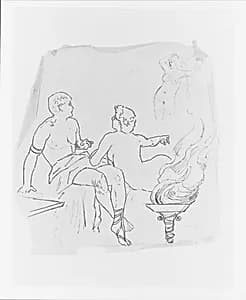
Mythological Figure Group (from Sketchbook)
ca. 1860
Medium
Graphite on paper
Dimensions
9 1/16 × 8 5/8 in. (23 × 21.9 cm)
Classification
Drawing
Culture
American
Department
The American Wing
Museum
Metropolitan Museum of Art, New York, NY
Credit
Gift of Edward R. Grove, 1985
Accession Number
1985.351.15 recto
Rights
Public Domain
Tags
Art Historical Context
Step into the preparatory world of 19th-century American sculpture with *Mythological Figure Group (from Sketchbook)* by John Quincy Adams Ward, 1860. This graphite drawing on paper, measuring just 9 1/16 × 8 5/8 inches, captures dynamic groupings of male and female nude—evoking classical myths through fluid, expressive lines. Ward, a pioneering neoclassical sculptor known for public monuments like the *Indian Hunter* in New York, often began his grand marble and bronze works with such sketchbook studies, translating ancient ideals into American artistic expression. Created during the Civil War era, when Ward was establishing himself as a leader in the National Academy of Design, this piece highlights the era's revival of mythological themes amid rapid industrialization. Graphite allowed for swift, gestural marks that convey anatomy, movement, and proportion—essential techniques for sculptors planning three-dimensional forms. The nude figures reflect Renaissance influences, emphasizing harmony and heroism, a nod to Ward's training under classical masters. Housed in The Metropolitan Museum of Art's American Wing as a gift from Edward R. Grove in 1985, this sketch offers a rare glimpse into an artist's creative process, bridging personal ideation with cultural legacy. It's a testament to how humble drawings fueled America's sculptural golden age.
About the Artist
John Quincy Adams Ward · 1830–1910
John Quincy Adams Ward (1830–1910) was born in Urbana, Ohio, the fourth of eight children, and displayed an early aptitude for three-dimensional form, modeling figures in clay from childhood. In 1849 he moved to Brooklyn, New York, to apprentice under the sculptor Henry Kirke Brown, with whom he worked for seven years. Brown's emphasis on American subjects and his conviction that sculpture should ...