
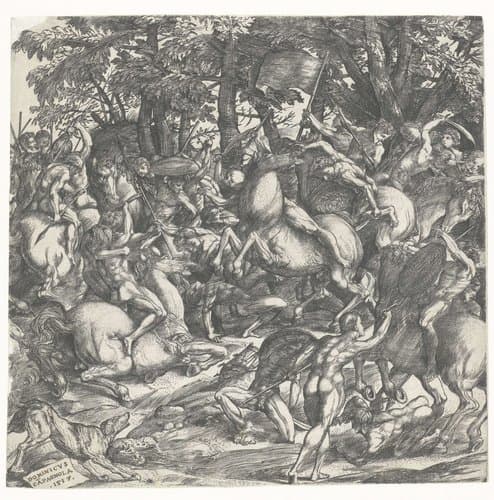
Naakte mannen met speren op paarden in gevecht
Medium
engraving
Dimensions
220; 226
Rights
Public Domain
About this artwork
Dit thema was populair in de vroege 16e eeuw en velen volgden het voorbeeld van Leonardo da Vinci's Slag bij Anghiari welke bekend werd van de vele voorstudies. De wijze waarop Titiaan het onderwerp verbeeldde lijkt nog het meest in de buurt de komen bij Campagnola"s interpretatie (zie documentatie).
Art Historical Context
Domenico Campagnola's *Naakte mannen met speren paarden in geve* (Naked Men with Spears on Horses in Combat an engraving from 1517, captures the raw energy of battle through dynamic figures of nude warriors clashing on horseback. Measuring 220 × 226 mm, this exemplifies the Venetian Renaissance mastery of line and form, with Campagnola— a skilled engraver and pupil influenced by Titian—employ intricate cross-hatching to convey motion, musculature, and tension. This dramatic scene draws from a popular early 16th-century motif inspired by Leonardo da Vinci's lost fresco *The Battle of Anghiari* (1503–1506), renowned through its numerous preparatory studies and copies. Artists across Italy emulated Leonardo's turbulent compositions of intertwined bodies and rearing horses to explore anatomy and movement. Notably, Titian's own battle depictions align most closely with Campagnola's interpretation, highlighting the print's role in disseminating influential designs. As an engraving, the work's significance lies in its reproducibility, allowing Renaissance ideals of heroic nudity and classical vigor—echoing ancient battle sarcophagi—to reach wider audiences beyond paintings. A testament to artistic dialogue, it invites visitors to trace the evolution of battle imagery from Leonardo's innovation to Venetian refinement.
About the Artist
Domenico Campagnola · 1500–1564
Domenico Campagnola (c. 1500–1564), a Venetian Renaissance painter, engraver, and pioneering draftsman, was born around 1500, likely in Venice to German parents, and became a child prodigy under the tutelage of his adoptive father, Giulio Campagnola. Apprenticed to Giulio around 1507 in Venice, he mastered painting, drawing, engraving, and woodcutting from the esteemed Paduan engraver, whose stipp...